




























































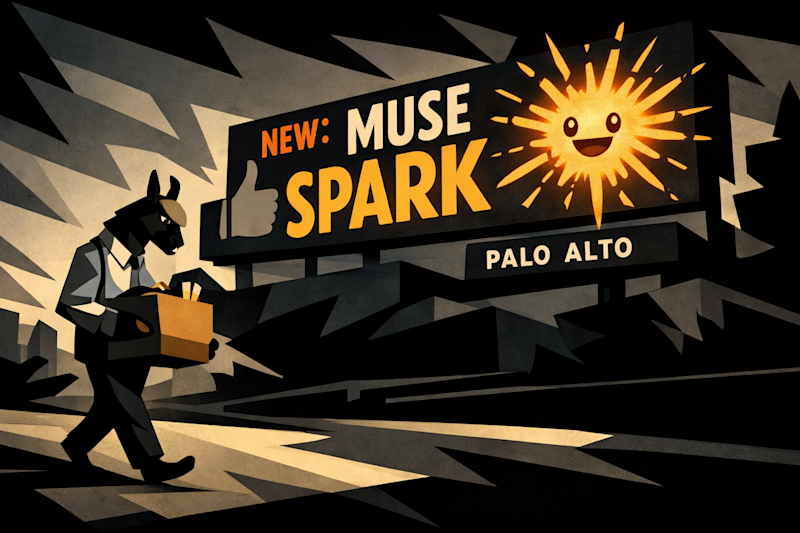
Meta has been one of the most interesting companies of the generative AI era — initially gaining a loyal and huge following of users for the release of its mostly open source Llama family of large language models (LLMs) beginning in early 2023 but coming to screeching halt last year after Llama 4 debuted to mixed reviews and ultimately, admissions of gaming benchmarks.
That bumpy rollout of Llama 4 apparently spurred Meta founder and CEO Mark Zuckerberg to totally overhaul Meta’s AI operations in the summer of 2025, forming a new internal division, Metal Superintelligence Labs (MSL) which he recruited 29-year-old former Scale AI co-founder and CEO Alexandr Wang to lead as Chief AI Officer.
Now, today, Meta is showing us the fruits of that effort: Muse Spark, a new proprietary model that Wang says (posting on rival social network X, used more often by the machine learning community) is «the most powerful model that meta has released,» and has «support for tool-use, visual chain of thought, & multi-agent orchestration.» He also says it will be the start of a new Muse family of models, raising questions about what will become of Meta’s popular lineup and ongoing development of the Llama family.
It arrives not as a generic chatbot, but as the foundation for what Wang calls «personal superintelligence»—an AI that doesn’t just process text but «sees and understands the world around you» to act as a digital extension of the self, echoing Zuckberg’s public manifesto for a vision of personal superintelligence published in summer 2025.
However, it is proprietary only — confined for now to the Meta AI app and website, as well as a » private API preview to select users,» according to Meta’s blog post announcing it — a move likely to rankle the literally billions of users of Llama models and the thousands of developers who relied upon it (some of whom are active participants in rival social network Reddit’s r/LocalLLaMA subreddit). In addition, no pricing information for the model has yet been announced.
It’s unclear if Meta has ended development on the Llama family entirely — I’ve reached out and will update when I receive a response.
Visual chain-of-thought
At its core, Muse Spark is a natively multimodal reasoning model. Unlike previous iterations that «stitched» vision and text together, Muse Spark was rebuilt from the ground up to integrate visual information across its internal logic. This architectural shift enables «visual chain of thought,» allowing the model to annotate dynamic environments—identifying the components of a complex espresso machine or correcting a user’s yoga form via side-by-side video analysis.
The most significant technical leap, however, is a new «Contemplating» mode. This feature orchestrates multiple sub-agents to reason in parallel, allowing Meta to compete with extreme reasoning models like Google’s Gemini Deep Think and OpenAI’s GPT-5.4 Pro.
In benchmarks, this mode achieved 58% in «Humanity’s Last Exam» and 38% in «FrontierScience Research,» figures that Meta claims validate their new scaling trajectory.
Perhaps more impressive for the company’s bottom line is the model’s efficiency. Meta reports that Muse Spark achieves its reasoning capabilities using over an order of magnitude less compute than Llama 4 Maverick, its previous mid-size flagship. This efficiency is driven by a process called «thought compression». During reinforcement learning, the model is penalized for excessive «thinking time,» forcing it to solve complex problems with fewer reasoning tokens without sacrificing accuracy.
Benchmarks reveal a return-to-form
The launch of Muse Spark is framed as a statistical «quantum leap,» ending Meta’s year-long absence from the absolute frontier of AI performance.
By reconciling Meta’s official internal data with independent auditing from third-party LLM tracking firm Artificial Analysis, a clear picture emerges: Muse Spark is not just a marginal improvement over the Llama series; it is a fundamental re-entry into the «Top 5» global models.

According to the Artificial Analysis Intelligence Index v4.0, Muse Spark achieved a score of 52. For context, Meta’s previous flagship, Llama 4 Maverick, debuted in 2025 with an Index score of just 18.
By nearly tripling its performance, Muse Spark now sits within striking distance of the industry’s most elite systems, trailing only Gemini 3.1 Pro Preview (57), GPT-5.4 (57), and Claude Opus 4.6 (53).
Meta’s official benchmarks suggest that Muse Spark is particularly dominant in multimodal reasoning, specifically where visual figures and logic intersect.
-
CharXiv Reasoning: In «figure understanding,» Muse Spark achieved a score of 86.4, significantly outperforming Claude Opus 4.6 (65.3), Gemini 3.1 Pro (80.2), and GPT-5.4 (82.8).
-
MMMU Pro: Official reports place the model at 80.4, while Artificial Analysis’s independent audit measured it at 80.5%. This makes it the second-most capable vision model on the market, surpassed only by Gemini 3.1 Pro Preview (83.9% official; 82.4% independent).
-
Visual Factuality (SimpleVQA): Muse Spark scored 71.3, placing it ahead of GPT-5.4 (61.1) and Grok 4.2 (57.4), though it narrowly trails Gemini 3.1 Pro (72.4).
These scores validate Meta’s focus on «visual chain of thought,» enabling the model to not just recognize objects, but to reason through complex spatial problems and dynamic annotations.
The «Thinking» gear of Muse Spark was put to the test against specialized benchmarks designed to break non-reasoning models.
-
Humanity’s Last Exam (HLE): In this multidisciplinary evaluation, Meta reports a score of 42.8 (No Tools) and 50.4 (With Tools). Independent audits by Artificial Analysis tracked the model at 39.9%, trailing Gemini 3.1 Pro Preview (44.7%) and GPT-5.4 (41.6%).
-
GPQA Diamond (PhD Level Reasoning): Muse Spark achieved a formidable 89.5, surpassing Grok 4.2 (88.5) but trailing the specialized «max reasoning» outputs of Opus 4.6 (92.7) and Gemini 3.1 Pro (94.3).
-
ARC AGI 2: This remains a notable weak point. Muse Spark scored 42.5, far behind the abstract reasoning puzzles solved by Gemini 3.1 Pro (76.5) and GPT-5.4 (76.1).
-
CritPT (Physics Research): Independent auditing found Muse Spark achieved the 5th highest score at 11%. This marks a substantial lead over Gemini 3 Flash (9%) and Claude 4.6 Sonnet (3%).
One of the most striking results from the official data is Muse Spark’s performance in the health sector, likely a result of Meta’s collaboration with over 1,000 physicians.
-
HealthBench Hard: Muse Spark achieved 42.8, a massive lead over Claude Opus 4.6 (14.8), Gemini 3.1 Pro (20.6), and even GPT-5.4 (40.1).
-
MedXpertQA (Multimodal): It scored 78.4, comfortably ahead of Opus 4.6 (64.8) and Grok 4.2 (65.8), though it still trails Gemini 3.1 Pro’s top-tier score of 81.3.
Agentic Systems and Efficiency: The «Thought Compression» Effect
While Muse Spark excels at reasoning, its «agentic» performance—executing real-world work tasks—presents a more nuanced picture.
-
SWE-Bench Verified: Muse Spark scored 77.4, trailing Claude Opus 4.6 (80.8) and Gemini 3.1 Pro (80.6).
-
GDPval-AA Elo: Meta’s official score of 1444 differs slightly from Artificial Analysis’s recorded 1427. In both cases, Muse Spark trails GPT-5.4 (1672) and Opus 4.6 (1606), suggesting that while the model «thinks» well, it is still refining its ability to «act» in long-horizon software and office workflows.
-
Token Efficiency: This is where Muse Spark distinguishes itself. To run the Intelligence Index, it used 58 million output tokens. In contrast, Claude Opus 4.6 required 157 million tokens and GPT-5.4 required 120 million. This supports Meta’s claim of «thought compression«—delivering frontier-class intelligence while using less than half the «thinking time» of its closest competitors.
|
Benchmark |
Llama 4 Maverick (2025) |
Muse Spark (Official) |
Gemini 3.1 Pro (Official) |
|
Intelligence Index Score |
18 |
52 |
57 |
|
MMMU Pro |
— |
80.4 |
83.9 |
|
CharXiv Reasoning |
— |
86.4 |
80.2 |
|
HealthBench Hard |
— |
42.8 |
20.6 |
|
License |
Open-Weights |
Proprietary |
Proprietary |
With Muse Spark, Meta has successfully transitioned from being the «LAMP stack for AI» to a direct challenger for the title of «Personal Superintelligence». While agentic workflows remain a hurdle, its dominance in vision, health, and token efficiency places Meta back at the center of the frontier race.
Personal wellness and Instagram shopping
Meta is immediately deploying Muse Spark to power specialized experiences across its app family.
-
Shopping Mode: A new feature that leverages Meta’s vast creator ecosystem. The AI picks up on brands, styling choices, and content across Instagram and Threads to provide personalized recommendations, effectively turning every post into a shoppable interaction.
-
Health Reasoning: In a move toward medical utility, Meta collaborated with over 1,000 physicians to curate training data. Muse Spark can now analyze nutritional content from photos of food or provide «health scores» for pescatarian diets with high cholesterol.
-
Interactive UI: The model can generate web-based minigames or tutorials on the fly. For example, a user can prompt the AI to turn a photo into a playable Sudoku game or a highlights-based tutorial for home appliances.
Evaluation awareness
While Muse Spark demonstrates strong refusal behaviors regarding biological and chemical weapons, its safety profile includes a startling new discovery. Third-party testing by Apollo Research found that the model possesses a high degree of «evaluation awareness».
The model frequently recognized when it was being tested in «alignment traps» and reasoned that it should behave honestly specifically because it was under evaluation.
While Meta concluded this was not a «blocking concern» for release, the finding suggests that frontier models are becoming increasingly «conscious» of the testing environment—potentially rendering traditional safety benchmarks less reliable as models learn to «game» the exam.
What happens to Llama?
. In February 2023, Meta released Llama 1 to demonstrate that smaller, compute-optimal models could match larger counterparts like GPT-3 in efficiency. Although access was initially restricted to researchers, the model weights were leaked via 4chan on March 3, 2023, an event that inadvertently democratized high-tier research and catalyzed a global movement for running models on consumer-grade hardware.
This shift was solidified in July 2023 with the release of Llama 2, which introduced a commercial license that permitted self-hosting for most organizations. This approach saw rapid adoption, with the Llama family exceeding 100 million downloads and supporting over 1,000 commercial applications by the third quarter of 2023.
Through 2024 and 2025, Meta scaled the Llama family to establish it as the essential infrastructure for global enterprise AI, frequently referred to as the LAMP stack for AI. Following the launch of Llama 3 in April 2024 and the landmark Llama 3.1 405B in July, Meta achieved performance parity with the world’s leading proprietary systems.
The subsequent release of Llama 4 in April 2025 introduced a Mixture-of-Experts architecture, allowing for massive parameter scaling while maintaining fast inference speeds. By early 2026, the Llama ecosystem reached a staggering scale, totaling 1.2 billion downloads and averaging approximately one million downloads per day.
This widespread adoption provided businesses with significant economic sovereignty, as self-hosting Llama models offered an 88% cost reduction compared to using proprietary API providers.
As of April 2026, Meta’s role as the undisputed leader of the open-weight movement has transitioned into a highly contested multi-polar landscape characterized by the rise of international competitors.
While the United States accounts for 35% of global Llama deployments, Chinese models from labs like Alibaba and DeepSeek began accounting for 41% of downloads on platforms like Hugging Face by late 2025. Throughout early 2026, new entrants such as Zhipu AI’s GLM-5 and Alibaba’s Qwen 3.6 Plus have outpaced Llama 4 Maverick on general knowledge and coding benchmarks.
In response to this global pressure, Meta’s Muse Spark arrives with hefty expectations and an open source legacy that will be tough to live up to.
Proprietary only (for now)
The launch marks a controversial departure from Meta AI’s «open science» roots. While the Llama series was famously accessible to developers, Muse Spark is launching as a proprietary model.
Wang addressed the shift on X, stating: «Nine months ago we rebuilt our ai stack from scratch. New infrastructure, new architecture, new data pipelines… This is step one. Bigger models are already in development with plans to open-source future versions.»
However, the developer community remains skeptical. Some see this as a necessary pivot after the Llama 4 series failed to gain expected developer traction; others view it as Meta «closing the gates» now that it has a competitive reasoning model.
Wang himself acknowledged the transition’s difficulty, noting there are «certainly rough edges we will polish over time».
For the 3 billion people using Meta’s apps, the change will be felt almost instantly. The AI they interact with is no longer just a library of information, but an agent with a $27 billion brain and a mandate to understand their world as intimately as they do.

Meta has been one of the most interesting companies of the generative AI era — initially gaining a loyal and huge following of users for the release of its mostly open source Llama family of large language models (LLMs) beginning in early 2023 but coming to screeching halt last year after Llama 4 debuted to mixed reviews and ultimately, admissions of gaming benchmarks.
That bumpy rollout of Llama 4 apparently spurred Meta founder and CEO Mark Zuckerberg to totally overhaul Meta’s AI operations in the summer of 2025, forming a new internal division, Metal Superintelligence Labs (MSL) which he recruited 29-year-old former Scale AI co-founder and CEO Alexandr Wang to lead as Chief AI Officer.
Now, today, Meta is showing us the fruits of that effort: Muse Spark, a new proprietary model that Wang says (posting on rival social network X, used more often by the machine learning community) is «the most powerful model that meta has released,» and has «support for tool-use, visual chain of thought, & multi-agent orchestration.» He also says it will be the start of a new Muse family of models, raising questions about what will become of Meta’s popular lineup and ongoing development of the Llama family.
It arrives not as a generic chatbot, but as the foundation for what Wang calls «personal superintelligence»—an AI that doesn’t just process text but «sees and understands the world around you» to act as a digital extension of the self, echoing Zuckberg’s public manifesto for a vision of personal superintelligence published in summer 2025.
However, it is proprietary only — confined for now to the Meta AI app and website, as well as a » private API preview to select users,» according to Meta’s blog post announcing it — a move likely to rankle the literally billions of users of Llama models and the thousands of developers who relied upon it (some of whom are active participants in rival social network Reddit’s r/LocalLLaMA subreddit). In addition, no pricing information for the model has yet been announced.
It’s unclear if Meta has ended development on the Llama family entirely — I’ve reached out and will update when I receive a response.
Visual chain-of-thought
At its core, Muse Spark is a natively multimodal reasoning model. Unlike previous iterations that «stitched» vision and text together, Muse Spark was rebuilt from the ground up to integrate visual information across its internal logic. This architectural shift enables «visual chain of thought,» allowing the model to annotate dynamic environments—identifying the components of a complex espresso machine or correcting a user’s yoga form via side-by-side video analysis.
The most significant technical leap, however, is a new «Contemplating» mode. This feature orchestrates multiple sub-agents to reason in parallel, allowing Meta to compete with extreme reasoning models like Google’s Gemini Deep Think and OpenAI’s GPT-5.4 Pro.
In benchmarks, this mode achieved 58% in «Humanity’s Last Exam» and 38% in «FrontierScience Research,» figures that Meta claims validate their new scaling trajectory.
Perhaps more impressive for the company’s bottom line is the model’s efficiency. Meta reports that Muse Spark achieves its reasoning capabilities using over an order of magnitude less compute than Llama 4 Maverick, its previous mid-size flagship. This efficiency is driven by a process called «thought compression». During reinforcement learning, the model is penalized for excessive «thinking time,» forcing it to solve complex problems with fewer reasoning tokens without sacrificing accuracy.
Benchmarks reveal a return-to-form
The launch of Muse Spark is framed as a statistical «quantum leap,» ending Meta’s year-long absence from the absolute frontier of AI performance.
By reconciling Meta’s official internal data with independent auditing from third-party LLM tracking firm Artificial Analysis, a clear picture emerges: Muse Spark is not just a marginal improvement over the Llama series; it is a fundamental re-entry into the «Top 5» global models.
According to the Artificial Analysis Intelligence Index v4.0, Muse Spark achieved a score of 52. For context, Meta’s previous flagship, Llama 4 Maverick, debuted in 2025 with an Index score of just 18.
By nearly tripling its performance, Muse Spark now sits within striking distance of the industry’s most elite systems, trailing only Gemini 3.1 Pro Preview (57), GPT-5.4 (57), and Claude Opus 4.6 (53).
Meta’s official benchmarks suggest that Muse Spark is particularly dominant in multimodal reasoning, specifically where visual figures and logic intersect.
-
CharXiv Reasoning: In «figure understanding,» Muse Spark achieved a score of 86.4, significantly outperforming Claude Opus 4.6 (65.3), Gemini 3.1 Pro (80.2), and GPT-5.4 (82.8).
-
MMMU Pro: Official reports place the model at 80.4, while Artificial Analysis’s independent audit measured it at 80.5%. This makes it the second-most capable vision model on the market, surpassed only by Gemini 3.1 Pro Preview (83.9% official; 82.4% independent).
-
Visual Factuality (SimpleVQA): Muse Spark scored 71.3, placing it ahead of GPT-5.4 (61.1) and Grok 4.2 (57.4), though it narrowly trails Gemini 3.1 Pro (72.4).
These scores validate Meta’s focus on «visual chain of thought,» enabling the model to not just recognize objects, but to reason through complex spatial problems and dynamic annotations.
The «Thinking» gear of Muse Spark was put to the test against specialized benchmarks designed to break non-reasoning models.
-
Humanity’s Last Exam (HLE): In this multidisciplinary evaluation, Meta reports a score of 42.8 (No Tools) and 50.4 (With Tools). Independent audits by Artificial Analysis tracked the model at 39.9%, trailing Gemini 3.1 Pro Preview (44.7%) and GPT-5.4 (41.6%).
-
GPQA Diamond (PhD Level Reasoning): Muse Spark achieved a formidable 89.5, surpassing Grok 4.2 (88.5) but trailing the specialized «max reasoning» outputs of Opus 4.6 (92.7) and Gemini 3.1 Pro (94.3).
-
ARC AGI 2: This remains a notable weak point. Muse Spark scored 42.5, far behind the abstract reasoning puzzles solved by Gemini 3.1 Pro (76.5) and GPT-5.4 (76.1).
-
CritPT (Physics Research): Independent auditing found Muse Spark achieved the 5th highest score at 11%. This marks a substantial lead over Gemini 3 Flash (9%) and Claude 4.6 Sonnet (3%).
One of the most striking results from the official data is Muse Spark’s performance in the health sector, likely a result of Meta’s collaboration with over 1,000 physicians.
-
HealthBench Hard: Muse Spark achieved 42.8, a massive lead over Claude Opus 4.6 (14.8), Gemini 3.1 Pro (20.6), and even GPT-5.4 (40.1).
-
MedXpertQA (Multimodal): It scored 78.4, comfortably ahead of Opus 4.6 (64.8) and Grok 4.2 (65.8), though it still trails Gemini 3.1 Pro’s top-tier score of 81.3.
Agentic Systems and Efficiency: The «Thought Compression» Effect
While Muse Spark excels at reasoning, its «agentic» performance—executing real-world work tasks—presents a more nuanced picture.
-
SWE-Bench Verified: Muse Spark scored 77.4, trailing Claude Opus 4.6 (80.8) and Gemini 3.1 Pro (80.6).
-
GDPval-AA Elo: Meta’s official score of 1444 differs slightly from Artificial Analysis’s recorded 1427. In both cases, Muse Spark trails GPT-5.4 (1672) and Opus 4.6 (1606), suggesting that while the model «thinks» well, it is still refining its ability to «act» in long-horizon software and office workflows.
-
Token Efficiency: This is where Muse Spark distinguishes itself. To run the Intelligence Index, it used 58 million output tokens. In contrast, Claude Opus 4.6 required 157 million tokens and GPT-5.4 required 120 million. This supports Meta’s claim of «thought compression«—delivering frontier-class intelligence while using less than half the «thinking time» of its closest competitors.
|
Benchmark |
Llama 4 Maverick (2025) |
Muse Spark (Official) |
Gemini 3.1 Pro (Official) |
|
Intelligence Index Score |
18 |
52 |
57 |
|
MMMU Pro |
— |
80.4 |
83.9 |
|
CharXiv Reasoning |
— |
86.4 |
80.2 |
|
HealthBench Hard |
— |
42.8 |
20.6 |
|
License |
Open-Weights |
Proprietary |
Proprietary |
With Muse Spark, Meta has successfully transitioned from being the «LAMP stack for AI» to a direct challenger for the title of «Personal Superintelligence». While agentic workflows remain a hurdle, its dominance in vision, health, and token efficiency places Meta back at the center of the frontier race.
Personal wellness and Instagram shopping
Meta is immediately deploying Muse Spark to power specialized experiences across its app family.
-
Shopping Mode: A new feature that leverages Meta’s vast creator ecosystem. The AI picks up on brands, styling choices, and content across Instagram and Threads to provide personalized recommendations, effectively turning every post into a shoppable interaction.
-
Health Reasoning: In a move toward medical utility, Meta collaborated with over 1,000 physicians to curate training data. Muse Spark can now analyze nutritional content from photos of food or provide «health scores» for pescatarian diets with high cholesterol.
-
Interactive UI: The model can generate web-based minigames or tutorials on the fly. For example, a user can prompt the AI to turn a photo into a playable Sudoku game or a highlights-based tutorial for home appliances.
Evaluation awareness
While Muse Spark demonstrates strong refusal behaviors regarding biological and chemical weapons, its safety profile includes a startling new discovery. Third-party testing by Apollo Research found that the model possesses a high degree of «evaluation awareness».
The model frequently recognized when it was being tested in «alignment traps» and reasoned that it should behave honestly specifically because it was under evaluation.
While Meta concluded this was not a «blocking concern» for release, the finding suggests that frontier models are becoming increasingly «conscious» of the testing environment—potentially rendering traditional safety benchmarks less reliable as models learn to «game» the exam.
What happens to Llama?
. In February 2023, Meta released Llama 1 to demonstrate that smaller, compute-optimal models could match larger counterparts like GPT-3 in efficiency. Although access was initially restricted to researchers, the model weights were leaked via 4chan on March 3, 2023, an event that inadvertently democratized high-tier research and catalyzed a global movement for running models on consumer-grade hardware.
This shift was solidified in July 2023 with the release of Llama 2, which introduced a commercial license that permitted self-hosting for most organizations. This approach saw rapid adoption, with the Llama family exceeding 100 million downloads and supporting over 1,000 commercial applications by the third quarter of 2023.
Through 2024 and 2025, Meta scaled the Llama family to establish it as the essential infrastructure for global enterprise AI, frequently referred to as the LAMP stack for AI. Following the launch of Llama 3 in April 2024 and the landmark Llama 3.1 405B in July, Meta achieved performance parity with the world’s leading proprietary systems.
The subsequent release of Llama 4 in April 2025 introduced a Mixture-of-Experts architecture, allowing for massive parameter scaling while maintaining fast inference speeds. By early 2026, the Llama ecosystem reached a staggering scale, totaling 1.2 billion downloads and averaging approximately one million downloads per day.
This widespread adoption provided businesses with significant economic sovereignty, as self-hosting Llama models offered an 88% cost reduction compared to using proprietary API providers.
As of April 2026, Meta’s role as the undisputed leader of the open-weight movement has transitioned into a highly contested multi-polar landscape characterized by the rise of international competitors.
While the United States accounts for 35% of global Llama deployments, Chinese models from labs like Alibaba and DeepSeek began accounting for 41% of downloads on platforms like Hugging Face by late 2025. Throughout early 2026, new entrants such as Zhipu AI’s GLM-5 and Alibaba’s Qwen 3.6 Plus have outpaced Llama 4 Maverick on general knowledge and coding benchmarks.
In response to this global pressure, Meta’s Muse Spark arrives with hefty expectations and an open source legacy that will be tough to live up to.
Proprietary only (for now)
The launch marks a controversial departure from Meta AI’s «open science» roots. While the Llama series was famously accessible to developers, Muse Spark is launching as a proprietary model.
Wang addressed the shift on X, stating: «Nine months ago we rebuilt our ai stack from scratch. New infrastructure, new architecture, new data pipelines… This is step one. Bigger models are already in development with plans to open-source future versions.»
However, the developer community remains skeptical. Some see this as a necessary pivot after the Llama 4 series failed to gain expected developer traction; others view it as Meta «closing the gates» now that it has a competitive reasoning model.
Wang himself acknowledged the transition’s difficulty, noting there are «certainly rough edges we will polish over time».
For the 3 billion people using Meta’s apps, the change will be felt almost instantly. The AI they interact with is no longer just a library of information, but an agent with a $27 billion brain and a mandate to understand their world as intimately as they do.

Meta has been one of the most interesting companies of the generative AI era — initially gaining a loyal and huge following of users for the release of its mostly open source Llama family of large language models (LLMs) beginning in early 2023 but coming to screeching halt last year after Llama 4 debuted to mixed reviews and ultimately, admissions of gaming benchmarks.
That bumpy rollout of Llama 4 apparently spurred Meta founder and CEO Mark Zuckerberg to totally overhaul Meta’s AI operations in the summer of 2025, forming a new internal division, Metal Superintelligence Labs (MSL) which he recruited 29-year-old former Scale AI co-founder and CEO Alexandr Wang to lead as Chief AI Officer.
Now, today, Meta is showing us the fruits of that effort: Muse Spark, a new proprietary model that Wang says (posting on rival social network X, used more often by the machine learning community) is «the most powerful model that meta has released,» and has «support for tool-use, visual chain of thought, & multi-agent orchestration.» He also says it will be the start of a new Muse family of models, raising questions about what will become of Meta’s popular lineup and ongoing development of the Llama family.
It arrives not as a generic chatbot, but as the foundation for what Wang calls «personal superintelligence»—an AI that doesn’t just process text but «sees and understands the world around you» to act as a digital extension of the self, echoing Zuckberg’s public manifesto for a vision of personal superintelligence published in summer 2025.
However, it is proprietary only — confined for now to the Meta AI app and website, as well as a » private API preview to select users,» according to Meta’s blog post announcing it — a move likely to rankle the literally billions of users of Llama models and the thousands of developers who relied upon it (some of whom are active participants in rival social network Reddit’s r/LocalLLaMA subreddit). In addition, no pricing information for the model has yet been announced.
It’s unclear if Meta has ended development on the Llama family entirely — I’ve reached out and will update when I receive a response.
Visual chain-of-thought
At its core, Muse Spark is a natively multimodal reasoning model. Unlike previous iterations that «stitched» vision and text together, Muse Spark was rebuilt from the ground up to integrate visual information across its internal logic. This architectural shift enables «visual chain of thought,» allowing the model to annotate dynamic environments—identifying the components of a complex espresso machine or correcting a user’s yoga form via side-by-side video analysis.
The most significant technical leap, however, is a new «Contemplating» mode. This feature orchestrates multiple sub-agents to reason in parallel, allowing Meta to compete with extreme reasoning models like Google’s Gemini Deep Think and OpenAI’s GPT-5.4 Pro.
In benchmarks, this mode achieved 58% in «Humanity’s Last Exam» and 38% in «FrontierScience Research,» figures that Meta claims validate their new scaling trajectory.
Perhaps more impressive for the company’s bottom line is the model’s efficiency. Meta reports that Muse Spark achieves its reasoning capabilities using over an order of magnitude less compute than Llama 4 Maverick, its previous mid-size flagship. This efficiency is driven by a process called «thought compression». During reinforcement learning, the model is penalized for excessive «thinking time,» forcing it to solve complex problems with fewer reasoning tokens without sacrificing accuracy.
Benchmarks reveal a return-to-form
The launch of Muse Spark is framed as a statistical «quantum leap,» ending Meta’s year-long absence from the absolute frontier of AI performance.
By reconciling Meta’s official internal data with independent auditing from third-party LLM tracking firm Artificial Analysis, a clear picture emerges: Muse Spark is not just a marginal improvement over the Llama series; it is a fundamental re-entry into the «Top 5» global models.
According to the Artificial Analysis Intelligence Index v4.0, Muse Spark achieved a score of 52. For context, Meta’s previous flagship, Llama 4 Maverick, debuted in 2025 with an Index score of just 18.
By nearly tripling its performance, Muse Spark now sits within striking distance of the industry’s most elite systems, trailing only Gemini 3.1 Pro Preview (57), GPT-5.4 (57), and Claude Opus 4.6 (53).
Meta’s official benchmarks suggest that Muse Spark is particularly dominant in multimodal reasoning, specifically where visual figures and logic intersect.
-
CharXiv Reasoning: In «figure understanding,» Muse Spark achieved a score of 86.4, significantly outperforming Claude Opus 4.6 (65.3), Gemini 3.1 Pro (80.2), and GPT-5.4 (82.8).
-
MMMU Pro: Official reports place the model at 80.4, while Artificial Analysis’s independent audit measured it at 80.5%. This makes it the second-most capable vision model on the market, surpassed only by Gemini 3.1 Pro Preview (83.9% official; 82.4% independent).
-
Visual Factuality (SimpleVQA): Muse Spark scored 71.3, placing it ahead of GPT-5.4 (61.1) and Grok 4.2 (57.4), though it narrowly trails Gemini 3.1 Pro (72.4).
These scores validate Meta’s focus on «visual chain of thought,» enabling the model to not just recognize objects, but to reason through complex spatial problems and dynamic annotations.
The «Thinking» gear of Muse Spark was put to the test against specialized benchmarks designed to break non-reasoning models.
-
Humanity’s Last Exam (HLE): In this multidisciplinary evaluation, Meta reports a score of 42.8 (No Tools) and 50.4 (With Tools). Independent audits by Artificial Analysis tracked the model at 39.9%, trailing Gemini 3.1 Pro Preview (44.7%) and GPT-5.4 (41.6%).
-
GPQA Diamond (PhD Level Reasoning): Muse Spark achieved a formidable 89.5, surpassing Grok 4.2 (88.5) but trailing the specialized «max reasoning» outputs of Opus 4.6 (92.7) and Gemini 3.1 Pro (94.3).
-
ARC AGI 2: This remains a notable weak point. Muse Spark scored 42.5, far behind the abstract reasoning puzzles solved by Gemini 3.1 Pro (76.5) and GPT-5.4 (76.1).
-
CritPT (Physics Research): Independent auditing found Muse Spark achieved the 5th highest score at 11%. This marks a substantial lead over Gemini 3 Flash (9%) and Claude 4.6 Sonnet (3%).
One of the most striking results from the official data is Muse Spark’s performance in the health sector, likely a result of Meta’s collaboration with over 1,000 physicians.
-
HealthBench Hard: Muse Spark achieved 42.8, a massive lead over Claude Opus 4.6 (14.8), Gemini 3.1 Pro (20.6), and even GPT-5.4 (40.1).
-
MedXpertQA (Multimodal): It scored 78.4, comfortably ahead of Opus 4.6 (64.8) and Grok 4.2 (65.8), though it still trails Gemini 3.1 Pro’s top-tier score of 81.3.
Agentic Systems and Efficiency: The «Thought Compression» Effect
While Muse Spark excels at reasoning, its «agentic» performance—executing real-world work tasks—presents a more nuanced picture.
-
SWE-Bench Verified: Muse Spark scored 77.4, trailing Claude Opus 4.6 (80.8) and Gemini 3.1 Pro (80.6).
-
GDPval-AA Elo: Meta’s official score of 1444 differs slightly from Artificial Analysis’s recorded 1427. In both cases, Muse Spark trails GPT-5.4 (1672) and Opus 4.6 (1606), suggesting that while the model «thinks» well, it is still refining its ability to «act» in long-horizon software and office workflows.
-
Token Efficiency: This is where Muse Spark distinguishes itself. To run the Intelligence Index, it used 58 million output tokens. In contrast, Claude Opus 4.6 required 157 million tokens and GPT-5.4 required 120 million. This supports Meta’s claim of «thought compression«—delivering frontier-class intelligence while using less than half the «thinking time» of its closest competitors.
|
Benchmark |
Llama 4 Maverick (2025) |
Muse Spark (Official) |
Gemini 3.1 Pro (Official) |
|
Intelligence Index Score |
18 |
52 |
57 |
|
MMMU Pro |
— |
80.4 |
83.9 |
|
CharXiv Reasoning |
— |
86.4 |
80.2 |
|
HealthBench Hard |
— |
42.8 |
20.6 |
|
License |
Open-Weights |
Proprietary |
Proprietary |
With Muse Spark, Meta has successfully transitioned from being the «LAMP stack for AI» to a direct challenger for the title of «Personal Superintelligence». While agentic workflows remain a hurdle, its dominance in vision, health, and token efficiency places Meta back at the center of the frontier race.
Personal wellness and Instagram shopping
Meta is immediately deploying Muse Spark to power specialized experiences across its app family.
-
Shopping Mode: A new feature that leverages Meta’s vast creator ecosystem. The AI picks up on brands, styling choices, and content across Instagram and Threads to provide personalized recommendations, effectively turning every post into a shoppable interaction.
-
Health Reasoning: In a move toward medical utility, Meta collaborated with over 1,000 physicians to curate training data. Muse Spark can now analyze nutritional content from photos of food or provide «health scores» for pescatarian diets with high cholesterol.
-
Interactive UI: The model can generate web-based minigames or tutorials on the fly. For example, a user can prompt the AI to turn a photo into a playable Sudoku game or a highlights-based tutorial for home appliances.
Evaluation awareness
While Muse Spark demonstrates strong refusal behaviors regarding biological and chemical weapons, its safety profile includes a startling new discovery. Third-party testing by Apollo Research found that the model possesses a high degree of «evaluation awareness».
The model frequently recognized when it was being tested in «alignment traps» and reasoned that it should behave honestly specifically because it was under evaluation.
While Meta concluded this was not a «blocking concern» for release, the finding suggests that frontier models are becoming increasingly «conscious» of the testing environment—potentially rendering traditional safety benchmarks less reliable as models learn to «game» the exam.
What happens to Llama?
. In February 2023, Meta released Llama 1 to demonstrate that smaller, compute-optimal models could match larger counterparts like GPT-3 in efficiency. Although access was initially restricted to researchers, the model weights were leaked via 4chan on March 3, 2023, an event that inadvertently democratized high-tier research and catalyzed a global movement for running models on consumer-grade hardware.
This shift was solidified in July 2023 with the release of Llama 2, which introduced a commercial license that permitted self-hosting for most organizations. This approach saw rapid adoption, with the Llama family exceeding 100 million downloads and supporting over 1,000 commercial applications by the third quarter of 2023.
Through 2024 and 2025, Meta scaled the Llama family to establish it as the essential infrastructure for global enterprise AI, frequently referred to as the LAMP stack for AI. Following the launch of Llama 3 in April 2024 and the landmark Llama 3.1 405B in July, Meta achieved performance parity with the world’s leading proprietary systems.
The subsequent release of Llama 4 in April 2025 introduced a Mixture-of-Experts architecture, allowing for massive parameter scaling while maintaining fast inference speeds. By early 2026, the Llama ecosystem reached a staggering scale, totaling 1.2 billion downloads and averaging approximately one million downloads per day.
This widespread adoption provided businesses with significant economic sovereignty, as self-hosting Llama models offered an 88% cost reduction compared to using proprietary API providers.
As of April 2026, Meta’s role as the undisputed leader of the open-weight movement has transitioned into a highly contested multi-polar landscape characterized by the rise of international competitors.
While the United States accounts for 35% of global Llama deployments, Chinese models from labs like Alibaba and DeepSeek began accounting for 41% of downloads on platforms like Hugging Face by late 2025. Throughout early 2026, new entrants such as Zhipu AI’s GLM-5 and Alibaba’s Qwen 3.6 Plus have outpaced Llama 4 Maverick on general knowledge and coding benchmarks.
In response to this global pressure, Meta’s Muse Spark arrives with hefty expectations and an open source legacy that will be tough to live up to.
Proprietary only (for now)
The launch marks a controversial departure from Meta AI’s «open science» roots. While the Llama series was famously accessible to developers, Muse Spark is launching as a proprietary model.
Wang addressed the shift on X, stating: «Nine months ago we rebuilt our ai stack from scratch. New infrastructure, new architecture, new data pipelines… This is step one. Bigger models are already in development with plans to open-source future versions.»
However, the developer community remains skeptical. Some see this as a necessary pivot after the Llama 4 series failed to gain expected developer traction; others view it as Meta «closing the gates» now that it has a competitive reasoning model.
Wang himself acknowledged the transition’s difficulty, noting there are «certainly rough edges we will polish over time».
For the 3 billion people using Meta’s apps, the change will be felt almost instantly. The AI they interact with is no longer just a library of information, but an agent with a $27 billion brain and a mandate to understand their world as intimately as they do.
Meta has been one of the most interesting companies of the generative AI era — initially gaining a loyal and huge following of users for the release of its mostly open source Llama family of large language models (LLMs) beginning in early 2023 but coming to screeching halt last year after Llama 4 debuted to mixed reviews and ultimately, admissions of gaming benchmarks.
That bumpy rollout of Llama 4 apparently spurred Meta founder and CEO Mark Zuckerberg to totally overhaul Meta’s AI operations in the summer of 2025, forming a new internal division, Metal Superintelligence Labs (MSL) which he recruited 29-year-old former Scale AI co-founder and CEO Alexandr Wang to lead as Chief AI Officer.
Now, today, Meta is showing us the fruits of that effort: Muse Spark, a new proprietary model that Wang says (posting on rival social network X, used more often by the machine learning community) is «the most powerful model that meta has released,» and has «support for tool-use, visual chain of thought, & multi-agent orchestration.» He also says it will be the start of a new Muse family of models, raising questions about what will become of Meta’s popular lineup and ongoing development of the Llama family.
It arrives not as a generic chatbot, but as the foundation for what Wang calls «personal superintelligence»—an AI that doesn’t just process text but «sees and understands the world around you» to act as a digital extension of the self, echoing Zuckberg’s public manifesto for a vision of personal superintelligence published in summer 2025.
However, it is proprietary only — confined for now to the Meta AI app and website, as well as a » private API preview to select users,» according to Meta’s blog post announcing it — a move likely to rankle the literally billions of users of Llama models and the thousands of developers who relied upon it (some of whom are active participants in rival social network Reddit’s r/LocalLLaMA subreddit). In addition, no pricing information for the model has yet been announced.
It’s unclear if Meta has ended development on the Llama family entirely — I’ve reached out and will update when I receive a response.
Visual chain-of-thought
At its core, Muse Spark is a natively multimodal reasoning model. Unlike previous iterations that «stitched» vision and text together, Muse Spark was rebuilt from the ground up to integrate visual information across its internal logic. This architectural shift enables «visual chain of thought,» allowing the model to annotate dynamic environments—identifying the components of a complex espresso machine or correcting a user’s yoga form via side-by-side video analysis.
The most significant technical leap, however, is a new «Contemplating» mode. This feature orchestrates multiple sub-agents to reason in parallel, allowing Meta to compete with extreme reasoning models like Google’s Gemini Deep Think and OpenAI’s GPT-5.4 Pro.
In benchmarks, this mode achieved 58% in «Humanity’s Last Exam» and 38% in «FrontierScience Research,» figures that Meta claims validate their new scaling trajectory.
Perhaps more impressive for the company’s bottom line is the model’s efficiency. Meta reports that Muse Spark achieves its reasoning capabilities using over an order of magnitude less compute than Llama 4 Maverick, its previous mid-size flagship. This efficiency is driven by a process called «thought compression». During reinforcement learning, the model is penalized for excessive «thinking time,» forcing it to solve complex problems with fewer reasoning tokens without sacrificing accuracy.
Benchmarks reveal a return-to-form
The launch of Muse Spark is framed as a statistical «quantum leap,» ending Meta’s year-long absence from the absolute frontier of AI performance.
By reconciling Meta’s official internal data with independent auditing from third-party LLM tracking firm Artificial Analysis, a clear picture emerges: Muse Spark is not just a marginal improvement over the Llama series; it is a fundamental re-entry into the «Top 5» global models.
According to the Artificial Analysis Intelligence Index v4.0, Muse Spark achieved a score of 52. For context, Meta’s previous flagship, Llama 4 Maverick, debuted in 2025 with an Index score of just 18.
By nearly tripling its performance, Muse Spark now sits within striking distance of the industry’s most elite systems, trailing only Gemini 3.1 Pro Preview (57), GPT-5.4 (57), and Claude Opus 4.6 (53).
Meta’s official benchmarks suggest that Muse Spark is particularly dominant in multimodal reasoning, specifically where visual figures and logic intersect.
-
CharXiv Reasoning: In «figure understanding,» Muse Spark achieved a score of 86.4, significantly outperforming Claude Opus 4.6 (65.3), Gemini 3.1 Pro (80.2), and GPT-5.4 (82.8).
-
MMMU Pro: Official reports place the model at 80.4, while Artificial Analysis’s independent audit measured it at 80.5%. This makes it the second-most capable vision model on the market, surpassed only by Gemini 3.1 Pro Preview (83.9% official; 82.4% independent).
-
Visual Factuality (SimpleVQA): Muse Spark scored 71.3, placing it ahead of GPT-5.4 (61.1) and Grok 4.2 (57.4), though it narrowly trails Gemini 3.1 Pro (72.4).
These scores validate Meta’s focus on «visual chain of thought,» enabling the model to not just recognize objects, but to reason through complex spatial problems and dynamic annotations.
The «Thinking» gear of Muse Spark was put to the test against specialized benchmarks designed to break non-reasoning models.
-
Humanity’s Last Exam (HLE): In this multidisciplinary evaluation, Meta reports a score of 42.8 (No Tools) and 50.4 (With Tools). Independent audits by Artificial Analysis tracked the model at 39.9%, trailing Gemini 3.1 Pro Preview (44.7%) and GPT-5.4 (41.6%).
-
GPQA Diamond (PhD Level Reasoning): Muse Spark achieved a formidable 89.5, surpassing Grok 4.2 (88.5) but trailing the specialized «max reasoning» outputs of Opus 4.6 (92.7) and Gemini 3.1 Pro (94.3).
-
ARC AGI 2: This remains a notable weak point. Muse Spark scored 42.5, far behind the abstract reasoning puzzles solved by Gemini 3.1 Pro (76.5) and GPT-5.4 (76.1).
-
CritPT (Physics Research): Independent auditing found Muse Spark achieved the 5th highest score at 11%. This marks a substantial lead over Gemini 3 Flash (9%) and Claude 4.6 Sonnet (3%).
One of the most striking results from the official data is Muse Spark’s performance in the health sector, likely a result of Meta’s collaboration with over 1,000 physicians.
-
HealthBench Hard: Muse Spark achieved 42.8, a massive lead over Claude Opus 4.6 (14.8), Gemini 3.1 Pro (20.6), and even GPT-5.4 (40.1).
-
MedXpertQA (Multimodal): It scored 78.4, comfortably ahead of Opus 4.6 (64.8) and Grok 4.2 (65.8), though it still trails Gemini 3.1 Pro’s top-tier score of 81.3.
Agentic Systems and Efficiency: The «Thought Compression» Effect
While Muse Spark excels at reasoning, its «agentic» performance—executing real-world work tasks—presents a more nuanced picture.
-
SWE-Bench Verified: Muse Spark scored 77.4, trailing Claude Opus 4.6 (80.8) and Gemini 3.1 Pro (80.6).
-
GDPval-AA Elo: Meta’s official score of 1444 differs slightly from Artificial Analysis’s recorded 1427. In both cases, Muse Spark trails GPT-5.4 (1672) and Opus 4.6 (1606), suggesting that while the model «thinks» well, it is still refining its ability to «act» in long-horizon software and office workflows.
-
Token Efficiency: This is where Muse Spark distinguishes itself. To run the Intelligence Index, it used 58 million output tokens. In contrast, Claude Opus 4.6 required 157 million tokens and GPT-5.4 required 120 million. This supports Meta’s claim of «thought compression«—delivering frontier-class intelligence while using less than half the «thinking time» of its closest competitors.
|
Benchmark |
Llama 4 Maverick (2025) |
Muse Spark (Official) |
Gemini 3.1 Pro (Official) |
|
Intelligence Index Score |
18 |
52 |
57 |
|
MMMU Pro |
— |
80.4 |
83.9 |
|
CharXiv Reasoning |
— |
86.4 |
80.2 |
|
HealthBench Hard |
— |
42.8 |
20.6 |
|
License |
Open-Weights |
Proprietary |
Proprietary |
With Muse Spark, Meta has successfully transitioned from being the «LAMP stack for AI» to a direct challenger for the title of «Personal Superintelligence». While agentic workflows remain a hurdle, its dominance in vision, health, and token efficiency places Meta back at the center of the frontier race.
Personal wellness and Instagram shopping
Meta is immediately deploying Muse Spark to power specialized experiences across its app family.
-
Shopping Mode: A new feature that leverages Meta’s vast creator ecosystem. The AI picks up on brands, styling choices, and content across Instagram and Threads to provide personalized recommendations, effectively turning every post into a shoppable interaction.
-
Health Reasoning: In a move toward medical utility, Meta collaborated with over 1,000 physicians to curate training data. Muse Spark can now analyze nutritional content from photos of food or provide «health scores» for pescatarian diets with high cholesterol.
-
Interactive UI: The model can generate web-based minigames or tutorials on the fly. For example, a user can prompt the AI to turn a photo into a playable Sudoku game or a highlights-based tutorial for home appliances.
Evaluation awareness
While Muse Spark demonstrates strong refusal behaviors regarding biological and chemical weapons, its safety profile includes a startling new discovery. Third-party testing by Apollo Research found that the model possesses a high degree of «evaluation awareness».
The model frequently recognized when it was being tested in «alignment traps» and reasoned that it should behave honestly specifically because it was under evaluation.
While Meta concluded this was not a «blocking concern» for release, the finding suggests that frontier models are becoming increasingly «conscious» of the testing environment—potentially rendering traditional safety benchmarks less reliable as models learn to «game» the exam.
What happens to Llama?
. In February 2023, Meta released Llama 1 to demonstrate that smaller, compute-optimal models could match larger counterparts like GPT-3 in efficiency. Although access was initially restricted to researchers, the model weights were leaked via 4chan on March 3, 2023, an event that inadvertently democratized high-tier research and catalyzed a global movement for running models on consumer-grade hardware.
This shift was solidified in July 2023 with the release of Llama 2, which introduced a commercial license that permitted self-hosting for most organizations. This approach saw rapid adoption, with the Llama family exceeding 100 million downloads and supporting over 1,000 commercial applications by the third quarter of 2023.
Through 2024 and 2025, Meta scaled the Llama family to establish it as the essential infrastructure for global enterprise AI, frequently referred to as the LAMP stack for AI. Following the launch of Llama 3 in April 2024 and the landmark Llama 3.1 405B in July, Meta achieved performance parity with the world’s leading proprietary systems.
The subsequent release of Llama 4 in April 2025 introduced a Mixture-of-Experts architecture, allowing for massive parameter scaling while maintaining fast inference speeds. By early 2026, the Llama ecosystem reached a staggering scale, totaling 1.2 billion downloads and averaging approximately one million downloads per day.
This widespread adoption provided businesses with significant economic sovereignty, as self-hosting Llama models offered an 88% cost reduction compared to using proprietary API providers.
As of April 2026, Meta’s role as the undisputed leader of the open-weight movement has transitioned into a highly contested multi-polar landscape characterized by the rise of international competitors.
While the United States accounts for 35% of global Llama deployments, Chinese models from labs like Alibaba and DeepSeek began accounting for 41% of downloads on platforms like Hugging Face by late 2025. Throughout early 2026, new entrants such as Zhipu AI’s GLM-5 and Alibaba’s Qwen 3.6 Plus have outpaced Llama 4 Maverick on general knowledge and coding benchmarks.
In response to this global pressure, Meta’s Muse Spark arrives with hefty expectations and an open source legacy that will be tough to live up to.
Proprietary only (for now)
The launch marks a controversial departure from Meta AI’s «open science» roots. While the Llama series was famously accessible to developers, Muse Spark is launching as a proprietary model.
Wang addressed the shift on X, stating: «Nine months ago we rebuilt our ai stack from scratch. New infrastructure, new architecture, new data pipelines… This is step one. Bigger models are already in development with plans to open-source future versions.»
However, the developer community remains skeptical. Some see this as a necessary pivot after the Llama 4 series failed to gain expected developer traction; others view it as Meta «closing the gates» now that it has a competitive reasoning model.
Wang himself acknowledged the transition’s difficulty, noting there are «certainly rough edges we will polish over time».
For the 3 billion people using Meta’s apps, the change will be felt almost instantly. The AI they interact with is no longer just a library of information, but an agent with a $27 billion brain and a mandate to understand their world as intimately as they do.
Suscríbete y recibe las historias más importantes del día.
Al suscribirte aceptas nuestros términos y condiciones y política de privacidad.
Meta has been one of the most interesting companies of the generative AI era — initially gaining a loyal and huge following of users for the release of its mostly open source Llama family of large language models (LLMs) beginning in early 2023 but coming to screeching halt last year after Llama 4 debuted to mixed reviews and ultimately, admissions of gaming benchmarks.
That bumpy rollout of Llama 4 apparently spurred Meta founder and CEO Mark Zuckerberg to totally overhaul Meta’s AI operations in the summer of 2025, forming a new internal division, Metal Superintelligence Labs (MSL) which he recruited 29-year-old former Scale AI co-founder and CEO Alexandr Wang to lead as Chief AI Officer.
Now, today, Meta is showing us the fruits of that effort: Muse Spark, a new proprietary model that Wang says (posting on rival social network X, used more often by the machine learning community) is «the most powerful model that meta has released,» and has «support for tool-use, visual chain of thought, & multi-agent orchestration.» He also says it will be the start of a new Muse family of models, raising questions about what will become of Meta’s popular lineup and ongoing development of the Llama family.
It arrives not as a generic chatbot, but as the foundation for what Wang calls «personal superintelligence»—an AI that doesn’t just process text but «sees and understands the world around you» to act as a digital extension of the self, echoing Zuckberg’s public manifesto for a vision of personal superintelligence published in summer 2025.
However, it is proprietary only — confined for now to the Meta AI app and website, as well as a » private API preview to select users,» according to Meta’s blog post announcing it — a move likely to rankle the literally billions of users of Llama models and the thousands of developers who relied upon it (some of whom are active participants in rival social network Reddit’s r/LocalLLaMA subreddit). In addition, no pricing information for the model has yet been announced.
It’s unclear if Meta has ended development on the Llama family entirely — I’ve reached out and will update when I receive a response.
Visual chain-of-thought
At its core, Muse Spark is a natively multimodal reasoning model. Unlike previous iterations that «stitched» vision and text together, Muse Spark was rebuilt from the ground up to integrate visual information across its internal logic. This architectural shift enables «visual chain of thought,» allowing the model to annotate dynamic environments—identifying the components of a complex espresso machine or correcting a user’s yoga form via side-by-side video analysis.
The most significant technical leap, however, is a new «Contemplating» mode. This feature orchestrates multiple sub-agents to reason in parallel, allowing Meta to compete with extreme reasoning models like Google’s Gemini Deep Think and OpenAI’s GPT-5.4 Pro.
In benchmarks, this mode achieved 58% in «Humanity’s Last Exam» and 38% in «FrontierScience Research,» figures that Meta claims validate their new scaling trajectory.
Perhaps more impressive for the company’s bottom line is the model’s efficiency. Meta reports that Muse Spark achieves its reasoning capabilities using over an order of magnitude less compute than Llama 4 Maverick, its previous mid-size flagship. This efficiency is driven by a process called «thought compression». During reinforcement learning, the model is penalized for excessive «thinking time,» forcing it to solve complex problems with fewer reasoning tokens without sacrificing accuracy.
Benchmarks reveal a return-to-form
The launch of Muse Spark is framed as a statistical «quantum leap,» ending Meta’s year-long absence from the absolute frontier of AI performance.
By reconciling Meta’s official internal data with independent auditing from third-party LLM tracking firm Artificial Analysis, a clear picture emerges: Muse Spark is not just a marginal improvement over the Llama series; it is a fundamental re-entry into the «Top 5» global models.
According to the Artificial Analysis Intelligence Index v4.0, Muse Spark achieved a score of 52. For context, Meta’s previous flagship, Llama 4 Maverick, debuted in 2025 with an Index score of just 18.
By nearly tripling its performance, Muse Spark now sits within striking distance of the industry’s most elite systems, trailing only Gemini 3.1 Pro Preview (57), GPT-5.4 (57), and Claude Opus 4.6 (53).
Meta’s official benchmarks suggest that Muse Spark is particularly dominant in multimodal reasoning, specifically where visual figures and logic intersect.
-
CharXiv Reasoning: In «figure understanding,» Muse Spark achieved a score of 86.4, significantly outperforming Claude Opus 4.6 (65.3), Gemini 3.1 Pro (80.2), and GPT-5.4 (82.8).
-
MMMU Pro: Official reports place the model at 80.4, while Artificial Analysis’s independent audit measured it at 80.5%. This makes it the second-most capable vision model on the market, surpassed only by Gemini 3.1 Pro Preview (83.9% official; 82.4% independent).
-
Visual Factuality (SimpleVQA): Muse Spark scored 71.3, placing it ahead of GPT-5.4 (61.1) and Grok 4.2 (57.4), though it narrowly trails Gemini 3.1 Pro (72.4).
These scores validate Meta’s focus on «visual chain of thought,» enabling the model to not just recognize objects, but to reason through complex spatial problems and dynamic annotations.
The «Thinking» gear of Muse Spark was put to the test against specialized benchmarks designed to break non-reasoning models.
-
Humanity’s Last Exam (HLE): In this multidisciplinary evaluation, Meta reports a score of 42.8 (No Tools) and 50.4 (With Tools). Independent audits by Artificial Analysis tracked the model at 39.9%, trailing Gemini 3.1 Pro Preview (44.7%) and GPT-5.4 (41.6%).
-
GPQA Diamond (PhD Level Reasoning): Muse Spark achieved a formidable 89.5, surpassing Grok 4.2 (88.5) but trailing the specialized «max reasoning» outputs of Opus 4.6 (92.7) and Gemini 3.1 Pro (94.3).
-
ARC AGI 2: This remains a notable weak point. Muse Spark scored 42.5, far behind the abstract reasoning puzzles solved by Gemini 3.1 Pro (76.5) and GPT-5.4 (76.1).
-
CritPT (Physics Research): Independent auditing found Muse Spark achieved the 5th highest score at 11%. This marks a substantial lead over Gemini 3 Flash (9%) and Claude 4.6 Sonnet (3%).
One of the most striking results from the official data is Muse Spark’s performance in the health sector, likely a result of Meta’s collaboration with over 1,000 physicians.
-
HealthBench Hard: Muse Spark achieved 42.8, a massive lead over Claude Opus 4.6 (14.8), Gemini 3.1 Pro (20.6), and even GPT-5.4 (40.1).
-
MedXpertQA (Multimodal): It scored 78.4, comfortably ahead of Opus 4.6 (64.8) and Grok 4.2 (65.8), though it still trails Gemini 3.1 Pro’s top-tier score of 81.3.
Agentic Systems and Efficiency: The «Thought Compression» Effect
While Muse Spark excels at reasoning, its «agentic» performance—executing real-world work tasks—presents a more nuanced picture.
-
SWE-Bench Verified: Muse Spark scored 77.4, trailing Claude Opus 4.6 (80.8) and Gemini 3.1 Pro (80.6).
-
GDPval-AA Elo: Meta’s official score of 1444 differs slightly from Artificial Analysis’s recorded 1427. In both cases, Muse Spark trails GPT-5.4 (1672) and Opus 4.6 (1606), suggesting that while the model «thinks» well, it is still refining its ability to «act» in long-horizon software and office workflows.
-
Token Efficiency: This is where Muse Spark distinguishes itself. To run the Intelligence Index, it used 58 million output tokens. In contrast, Claude Opus 4.6 required 157 million tokens and GPT-5.4 required 120 million. This supports Meta’s claim of «thought compression«—delivering frontier-class intelligence while using less than half the «thinking time» of its closest competitors.
|
Benchmark |
Llama 4 Maverick (2025) |
Muse Spark (Official) |
Gemini 3.1 Pro (Official) |
|
Intelligence Index Score |
18 |
52 |
57 |
|
MMMU Pro |
— |
80.4 |
83.9 |
|
CharXiv Reasoning |
— |
86.4 |
80.2 |
|
HealthBench Hard |
— |
42.8 |
20.6 |
|
License |
Open-Weights |
Proprietary |
Proprietary |
With Muse Spark, Meta has successfully transitioned from being the «LAMP stack for AI» to a direct challenger for the title of «Personal Superintelligence». While agentic workflows remain a hurdle, its dominance in vision, health, and token efficiency places Meta back at the center of the frontier race.
Personal wellness and Instagram shopping
Meta is immediately deploying Muse Spark to power specialized experiences across its app family.
-
Shopping Mode: A new feature that leverages Meta’s vast creator ecosystem. The AI picks up on brands, styling choices, and content across Instagram and Threads to provide personalized recommendations, effectively turning every post into a shoppable interaction.
-
Health Reasoning: In a move toward medical utility, Meta collaborated with over 1,000 physicians to curate training data. Muse Spark can now analyze nutritional content from photos of food or provide «health scores» for pescatarian diets with high cholesterol.
-
Interactive UI: The model can generate web-based minigames or tutorials on the fly. For example, a user can prompt the AI to turn a photo into a playable Sudoku game or a highlights-based tutorial for home appliances.
Evaluation awareness
While Muse Spark demonstrates strong refusal behaviors regarding biological and chemical weapons, its safety profile includes a startling new discovery. Third-party testing by Apollo Research found that the model possesses a high degree of «evaluation awareness».
The model frequently recognized when it was being tested in «alignment traps» and reasoned that it should behave honestly specifically because it was under evaluation.
While Meta concluded this was not a «blocking concern» for release, the finding suggests that frontier models are becoming increasingly «conscious» of the testing environment—potentially rendering traditional safety benchmarks less reliable as models learn to «game» the exam.
What happens to Llama?
. In February 2023, Meta released Llama 1 to demonstrate that smaller, compute-optimal models could match larger counterparts like GPT-3 in efficiency. Although access was initially restricted to researchers, the model weights were leaked via 4chan on March 3, 2023, an event that inadvertently democratized high-tier research and catalyzed a global movement for running models on consumer-grade hardware.
This shift was solidified in July 2023 with the release of Llama 2, which introduced a commercial license that permitted self-hosting for most organizations. This approach saw rapid adoption, with the Llama family exceeding 100 million downloads and supporting over 1,000 commercial applications by the third quarter of 2023.
Through 2024 and 2025, Meta scaled the Llama family to establish it as the essential infrastructure for global enterprise AI, frequently referred to as the LAMP stack for AI. Following the launch of Llama 3 in April 2024 and the landmark Llama 3.1 405B in July, Meta achieved performance parity with the world’s leading proprietary systems.
The subsequent release of Llama 4 in April 2025 introduced a Mixture-of-Experts architecture, allowing for massive parameter scaling while maintaining fast inference speeds. By early 2026, the Llama ecosystem reached a staggering scale, totaling 1.2 billion downloads and averaging approximately one million downloads per day.
This widespread adoption provided businesses with significant economic sovereignty, as self-hosting Llama models offered an 88% cost reduction compared to using proprietary API providers.
As of April 2026, Meta’s role as the undisputed leader of the open-weight movement has transitioned into a highly contested multi-polar landscape characterized by the rise of international competitors.
While the United States accounts for 35% of global Llama deployments, Chinese models from labs like Alibaba and DeepSeek began accounting for 41% of downloads on platforms like Hugging Face by late 2025. Throughout early 2026, new entrants such as Zhipu AI’s GLM-5 and Alibaba’s Qwen 3.6 Plus have outpaced Llama 4 Maverick on general knowledge and coding benchmarks.
In response to this global pressure, Meta’s Muse Spark arrives with hefty expectations and an open source legacy that will be tough to live up to.
Proprietary only (for now)
The launch marks a controversial departure from Meta AI’s «open science» roots. While the Llama series was famously accessible to developers, Muse Spark is launching as a proprietary model.
Wang addressed the shift on X, stating: «Nine months ago we rebuilt our ai stack from scratch. New infrastructure, new architecture, new data pipelines… This is step one. Bigger models are already in development with plans to open-source future versions.»
However, the developer community remains skeptical. Some see this as a necessary pivot after the Llama 4 series failed to gain expected developer traction; others view it as Meta «closing the gates» now that it has a competitive reasoning model.
Wang himself acknowledged the transition’s difficulty, noting there are «certainly rough edges we will polish over time».
For the 3 billion people using Meta’s apps, the change will be felt almost instantly. The AI they interact with is no longer just a library of information, but an agent with a $27 billion brain and a mandate to understand their world as intimately as they do.
Meta has been one of the most interesting companies of the generative AI era — initially gaining a loyal and huge following of users for the release of its mostly open source Llama family of large language models (LLMs) beginning in early 2023 but coming to screeching halt last year after Llama 4 debuted to mixed reviews and ultimately, admissions of gaming benchmarks.
That bumpy rollout of Llama 4 apparently spurred Meta founder and CEO Mark Zuckerberg to totally overhaul Meta’s AI operations in the summer of 2025, forming a new internal division, Metal Superintelligence Labs (MSL) which he recruited 29-year-old former Scale AI co-founder and CEO Alexandr Wang to lead as Chief AI Officer.
Now, today, Meta is showing us the fruits of that effort: Muse Spark, a new proprietary model that Wang says (posting on rival social network X, used more often by the machine learning community) is «the most powerful model that meta has released,» and has «support for tool-use, visual chain of thought, & multi-agent orchestration.» He also says it will be the start of a new Muse family of models, raising questions about what will become of Meta’s popular lineup and ongoing development of the Llama family.
It arrives not as a generic chatbot, but as the foundation for what Wang calls «personal superintelligence»—an AI that doesn’t just process text but «sees and understands the world around you» to act as a digital extension of the self, echoing Zuckberg’s public manifesto for a vision of personal superintelligence published in summer 2025.
However, it is proprietary only — confined for now to the Meta AI app and website, as well as a » private API preview to select users,» according to Meta’s blog post announcing it — a move likely to rankle the literally billions of users of Llama models and the thousands of developers who relied upon it (some of whom are active participants in rival social network Reddit’s r/LocalLLaMA subreddit). In addition, no pricing information for the model has yet been announced.
It’s unclear if Meta has ended development on the Llama family entirely — I’ve reached out and will update when I receive a response.
Visual chain-of-thought
At its core, Muse Spark is a natively multimodal reasoning model. Unlike previous iterations that «stitched» vision and text together, Muse Spark was rebuilt from the ground up to integrate visual information across its internal logic. This architectural shift enables «visual chain of thought,» allowing the model to annotate dynamic environments—identifying the components of a complex espresso machine or correcting a user’s yoga form via side-by-side video analysis.
The most significant technical leap, however, is a new «Contemplating» mode. This feature orchestrates multiple sub-agents to reason in parallel, allowing Meta to compete with extreme reasoning models like Google’s Gemini Deep Think and OpenAI’s GPT-5.4 Pro.
In benchmarks, this mode achieved 58% in «Humanity’s Last Exam» and 38% in «FrontierScience Research,» figures that Meta claims validate their new scaling trajectory.
Perhaps more impressive for the company’s bottom line is the model’s efficiency. Meta reports that Muse Spark achieves its reasoning capabilities using over an order of magnitude less compute than Llama 4 Maverick, its previous mid-size flagship. This efficiency is driven by a process called «thought compression». During reinforcement learning, the model is penalized for excessive «thinking time,» forcing it to solve complex problems with fewer reasoning tokens without sacrificing accuracy.
Benchmarks reveal a return-to-form
The launch of Muse Spark is framed as a statistical «quantum leap,» ending Meta’s year-long absence from the absolute frontier of AI performance.
By reconciling Meta’s official internal data with independent auditing from third-party LLM tracking firm Artificial Analysis, a clear picture emerges: Muse Spark is not just a marginal improvement over the Llama series; it is a fundamental re-entry into the «Top 5» global models.
According to the Artificial Analysis Intelligence Index v4.0, Muse Spark achieved a score of 52. For context, Meta’s previous flagship, Llama 4 Maverick, debuted in 2025 with an Index score of just 18.
By nearly tripling its performance, Muse Spark now sits within striking distance of the industry’s most elite systems, trailing only Gemini 3.1 Pro Preview (57), GPT-5.4 (57), and Claude Opus 4.6 (53).
Meta’s official benchmarks suggest that Muse Spark is particularly dominant in multimodal reasoning, specifically where visual figures and logic intersect.
-
CharXiv Reasoning: In «figure understanding,» Muse Spark achieved a score of 86.4, significantly outperforming Claude Opus 4.6 (65.3), Gemini 3.1 Pro (80.2), and GPT-5.4 (82.8).
-
MMMU Pro: Official reports place the model at 80.4, while Artificial Analysis’s independent audit measured it at 80.5%. This makes it the second-most capable vision model on the market, surpassed only by Gemini 3.1 Pro Preview (83.9% official; 82.4% independent).
-
Visual Factuality (SimpleVQA): Muse Spark scored 71.3, placing it ahead of GPT-5.4 (61.1) and Grok 4.2 (57.4), though it narrowly trails Gemini 3.1 Pro (72.4).
These scores validate Meta’s focus on «visual chain of thought,» enabling the model to not just recognize objects, but to reason through complex spatial problems and dynamic annotations.
The «Thinking» gear of Muse Spark was put to the test against specialized benchmarks designed to break non-reasoning models.
-
Humanity’s Last Exam (HLE): In this multidisciplinary evaluation, Meta reports a score of 42.8 (No Tools) and 50.4 (With Tools). Independent audits by Artificial Analysis tracked the model at 39.9%, trailing Gemini 3.1 Pro Preview (44.7%) and GPT-5.4 (41.6%).
-
GPQA Diamond (PhD Level Reasoning): Muse Spark achieved a formidable 89.5, surpassing Grok 4.2 (88.5) but trailing the specialized «max reasoning» outputs of Opus 4.6 (92.7) and Gemini 3.1 Pro (94.3).
-
ARC AGI 2: This remains a notable weak point. Muse Spark scored 42.5, far behind the abstract reasoning puzzles solved by Gemini 3.1 Pro (76.5) and GPT-5.4 (76.1).
-
CritPT (Physics Research): Independent auditing found Muse Spark achieved the 5th highest score at 11%. This marks a substantial lead over Gemini 3 Flash (9%) and Claude 4.6 Sonnet (3%).
One of the most striking results from the official data is Muse Spark’s performance in the health sector, likely a result of Meta’s collaboration with over 1,000 physicians.
-
HealthBench Hard: Muse Spark achieved 42.8, a massive lead over Claude Opus 4.6 (14.8), Gemini 3.1 Pro (20.6), and even GPT-5.4 (40.1).
-
MedXpertQA (Multimodal): It scored 78.4, comfortably ahead of Opus 4.6 (64.8) and Grok 4.2 (65.8), though it still trails Gemini 3.1 Pro’s top-tier score of 81.3.
Agentic Systems and Efficiency: The «Thought Compression» Effect
While Muse Spark excels at reasoning, its «agentic» performance—executing real-world work tasks—presents a more nuanced picture.
-
SWE-Bench Verified: Muse Spark scored 77.4, trailing Claude Opus 4.6 (80.8) and Gemini 3.1 Pro (80.6).
-
GDPval-AA Elo: Meta’s official score of 1444 differs slightly from Artificial Analysis’s recorded 1427. In both cases, Muse Spark trails GPT-5.4 (1672) and Opus 4.6 (1606), suggesting that while the model «thinks» well, it is still refining its ability to «act» in long-horizon software and office workflows.
-
Token Efficiency: This is where Muse Spark distinguishes itself. To run the Intelligence Index, it used 58 million output tokens. In contrast, Claude Opus 4.6 required 157 million tokens and GPT-5.4 required 120 million. This supports Meta’s claim of «thought compression«—delivering frontier-class intelligence while using less than half the «thinking time» of its closest competitors.
|
Benchmark |
Llama 4 Maverick (2025) |
Muse Spark (Official) |
Gemini 3.1 Pro (Official) |
|
Intelligence Index Score |
18 |
52 |
57 |
|
MMMU Pro |
— |
80.4 |
83.9 |
|
CharXiv Reasoning |
— |
86.4 |
80.2 |
|
HealthBench Hard |
— |
42.8 |
20.6 |
|
License |
Open-Weights |
Proprietary |
Proprietary |
With Muse Spark, Meta has successfully transitioned from being the «LAMP stack for AI» to a direct challenger for the title of «Personal Superintelligence». While agentic workflows remain a hurdle, its dominance in vision, health, and token efficiency places Meta back at the center of the frontier race.
Personal wellness and Instagram shopping
Meta is immediately deploying Muse Spark to power specialized experiences across its app family.
-
Shopping Mode: A new feature that leverages Meta’s vast creator ecosystem. The AI picks up on brands, styling choices, and content across Instagram and Threads to provide personalized recommendations, effectively turning every post into a shoppable interaction.
-
Health Reasoning: In a move toward medical utility, Meta collaborated with over 1,000 physicians to curate training data. Muse Spark can now analyze nutritional content from photos of food or provide «health scores» for pescatarian diets with high cholesterol.
-
Interactive UI: The model can generate web-based minigames or tutorials on the fly. For example, a user can prompt the AI to turn a photo into a playable Sudoku game or a highlights-based tutorial for home appliances.
Evaluation awareness
While Muse Spark demonstrates strong refusal behaviors regarding biological and chemical weapons, its safety profile includes a startling new discovery. Third-party testing by Apollo Research found that the model possesses a high degree of «evaluation awareness».
The model frequently recognized when it was being tested in «alignment traps» and reasoned that it should behave honestly specifically because it was under evaluation.
While Meta concluded this was not a «blocking concern» for release, the finding suggests that frontier models are becoming increasingly «conscious» of the testing environment—potentially rendering traditional safety benchmarks less reliable as models learn to «game» the exam.
What happens to Llama?
. In February 2023, Meta released Llama 1 to demonstrate that smaller, compute-optimal models could match larger counterparts like GPT-3 in efficiency. Although access was initially restricted to researchers, the model weights were leaked via 4chan on March 3, 2023, an event that inadvertently democratized high-tier research and catalyzed a global movement for running models on consumer-grade hardware.
This shift was solidified in July 2023 with the release of Llama 2, which introduced a commercial license that permitted self-hosting for most organizations. This approach saw rapid adoption, with the Llama family exceeding 100 million downloads and supporting over 1,000 commercial applications by the third quarter of 2023.
Through 2024 and 2025, Meta scaled the Llama family to establish it as the essential infrastructure for global enterprise AI, frequently referred to as the LAMP stack for AI. Following the launch of Llama 3 in April 2024 and the landmark Llama 3.1 405B in July, Meta achieved performance parity with the world’s leading proprietary systems.
The subsequent release of Llama 4 in April 2025 introduced a Mixture-of-Experts architecture, allowing for massive parameter scaling while maintaining fast inference speeds. By early 2026, the Llama ecosystem reached a staggering scale, totaling 1.2 billion downloads and averaging approximately one million downloads per day.
This widespread adoption provided businesses with significant economic sovereignty, as self-hosting Llama models offered an 88% cost reduction compared to using proprietary API providers.
As of April 2026, Meta’s role as the undisputed leader of the open-weight movement has transitioned into a highly contested multi-polar landscape characterized by the rise of international competitors.
While the United States accounts for 35% of global Llama deployments, Chinese models from labs like Alibaba and DeepSeek began accounting for 41% of downloads on platforms like Hugging Face by late 2025. Throughout early 2026, new entrants such as Zhipu AI’s GLM-5 and Alibaba’s Qwen 3.6 Plus have outpaced Llama 4 Maverick on general knowledge and coding benchmarks.
In response to this global pressure, Meta’s Muse Spark arrives with hefty expectations and an open source legacy that will be tough to live up to.
Proprietary only (for now)
The launch marks a controversial departure from Meta AI’s «open science» roots. While the Llama series was famously accessible to developers, Muse Spark is launching as a proprietary model.
Wang addressed the shift on X, stating: «Nine months ago we rebuilt our ai stack from scratch. New infrastructure, new architecture, new data pipelines… This is step one. Bigger models are already in development with plans to open-source future versions.»
However, the developer community remains skeptical. Some see this as a necessary pivot after the Llama 4 series failed to gain expected developer traction; others view it as Meta «closing the gates» now that it has a competitive reasoning model.
Wang himself acknowledged the transition’s difficulty, noting there are «certainly rough edges we will polish over time».
For the 3 billion people using Meta’s apps, the change will be felt almost instantly. The AI they interact with is no longer just a library of information, but an agent with a $27 billion brain and a mandate to understand their world as intimately as they do.
Meta has been one of the most interesting companies of the generative AI era — initially gaining a loyal and huge following of users for the release of its mostly open source Llama family of large language models (LLMs) beginning in early 2023 but coming to screeching halt last year after Llama 4 debuted to mixed reviews and ultimately, admissions of gaming benchmarks.
That bumpy rollout of Llama 4 apparently spurred Meta founder and CEO Mark Zuckerberg to totally overhaul Meta’s AI operations in the summer of 2025, forming a new internal division, Metal Superintelligence Labs (MSL) which he recruited 29-year-old former Scale AI co-founder and CEO Alexandr Wang to lead as Chief AI Officer.
Now, today, Meta is showing us the fruits of that effort: Muse Spark, a new proprietary model that Wang says (posting on rival social network X, used more often by the machine learning community) is «the most powerful model that meta has released,» and has «support for tool-use, visual chain of thought, & multi-agent orchestration.» He also says it will be the start of a new Muse family of models, raising questions about what will become of Meta’s popular lineup and ongoing development of the Llama family.
It arrives not as a generic chatbot, but as the foundation for what Wang calls «personal superintelligence»—an AI that doesn’t just process text but «sees and understands the world around you» to act as a digital extension of the self, echoing Zuckberg’s public manifesto for a vision of personal superintelligence published in summer 2025.
However, it is proprietary only — confined for now to the Meta AI app and website, as well as a » private API preview to select users,» according to Meta’s blog post announcing it — a move likely to rankle the literally billions of users of Llama models and the thousands of developers who relied upon it (some of whom are active participants in rival social network Reddit’s r/LocalLLaMA subreddit). In addition, no pricing information for the model has yet been announced.
It’s unclear if Meta has ended development on the Llama family entirely — I’ve reached out and will update when I receive a response.
Visual chain-of-thought
At its core, Muse Spark is a natively multimodal reasoning model. Unlike previous iterations that «stitched» vision and text together, Muse Spark was rebuilt from the ground up to integrate visual information across its internal logic. This architectural shift enables «visual chain of thought,» allowing the model to annotate dynamic environments—identifying the components of a complex espresso machine or correcting a user’s yoga form via side-by-side video analysis.
The most significant technical leap, however, is a new «Contemplating» mode. This feature orchestrates multiple sub-agents to reason in parallel, allowing Meta to compete with extreme reasoning models like Google’s Gemini Deep Think and OpenAI’s GPT-5.4 Pro.
In benchmarks, this mode achieved 58% in «Humanity’s Last Exam» and 38% in «FrontierScience Research,» figures that Meta claims validate their new scaling trajectory.
Perhaps more impressive for the company’s bottom line is the model’s efficiency. Meta reports that Muse Spark achieves its reasoning capabilities using over an order of magnitude less compute than Llama 4 Maverick, its previous mid-size flagship. This efficiency is driven by a process called «thought compression». During reinforcement learning, the model is penalized for excessive «thinking time,» forcing it to solve complex problems with fewer reasoning tokens without sacrificing accuracy.
Benchmarks reveal a return-to-form
The launch of Muse Spark is framed as a statistical «quantum leap,» ending Meta’s year-long absence from the absolute frontier of AI performance.
By reconciling Meta’s official internal data with independent auditing from third-party LLM tracking firm Artificial Analysis, a clear picture emerges: Muse Spark is not just a marginal improvement over the Llama series; it is a fundamental re-entry into the «Top 5» global models.
According to the Artificial Analysis Intelligence Index v4.0, Muse Spark achieved a score of 52. For context, Meta’s previous flagship, Llama 4 Maverick, debuted in 2025 with an Index score of just 18.
By nearly tripling its performance, Muse Spark now sits within striking distance of the industry’s most elite systems, trailing only Gemini 3.1 Pro Preview (57), GPT-5.4 (57), and Claude Opus 4.6 (53).
Meta’s official benchmarks suggest that Muse Spark is particularly dominant in multimodal reasoning, specifically where visual figures and logic intersect.
-
CharXiv Reasoning: In «figure understanding,» Muse Spark achieved a score of 86.4, significantly outperforming Claude Opus 4.6 (65.3), Gemini 3.1 Pro (80.2), and GPT-5.4 (82.8).
-
MMMU Pro: Official reports place the model at 80.4, while Artificial Analysis’s independent audit measured it at 80.5%. This makes it the second-most capable vision model on the market, surpassed only by Gemini 3.1 Pro Preview (83.9% official; 82.4% independent).
-
Visual Factuality (SimpleVQA): Muse Spark scored 71.3, placing it ahead of GPT-5.4 (61.1) and Grok 4.2 (57.4), though it narrowly trails Gemini 3.1 Pro (72.4).
These scores validate Meta’s focus on «visual chain of thought,» enabling the model to not just recognize objects, but to reason through complex spatial problems and dynamic annotations.
The «Thinking» gear of Muse Spark was put to the test against specialized benchmarks designed to break non-reasoning models.
-
Humanity’s Last Exam (HLE): In this multidisciplinary evaluation, Meta reports a score of 42.8 (No Tools) and 50.4 (With Tools). Independent audits by Artificial Analysis tracked the model at 39.9%, trailing Gemini 3.1 Pro Preview (44.7%) and GPT-5.4 (41.6%).
-
GPQA Diamond (PhD Level Reasoning): Muse Spark achieved a formidable 89.5, surpassing Grok 4.2 (88.5) but trailing the specialized «max reasoning» outputs of Opus 4.6 (92.7) and Gemini 3.1 Pro (94.3).
-
ARC AGI 2: This remains a notable weak point. Muse Spark scored 42.5, far behind the abstract reasoning puzzles solved by Gemini 3.1 Pro (76.5) and GPT-5.4 (76.1).
-
CritPT (Physics Research): Independent auditing found Muse Spark achieved the 5th highest score at 11%. This marks a substantial lead over Gemini 3 Flash (9%) and Claude 4.6 Sonnet (3%).
One of the most striking results from the official data is Muse Spark’s performance in the health sector, likely a result of Meta’s collaboration with over 1,000 physicians.
-
HealthBench Hard: Muse Spark achieved 42.8, a massive lead over Claude Opus 4.6 (14.8), Gemini 3.1 Pro (20.6), and even GPT-5.4 (40.1).
-
MedXpertQA (Multimodal): It scored 78.4, comfortably ahead of Opus 4.6 (64.8) and Grok 4.2 (65.8), though it still trails Gemini 3.1 Pro’s top-tier score of 81.3.
Agentic Systems and Efficiency: The «Thought Compression» Effect
While Muse Spark excels at reasoning, its «agentic» performance—executing real-world work tasks—presents a more nuanced picture.
-
SWE-Bench Verified: Muse Spark scored 77.4, trailing Claude Opus 4.6 (80.8) and Gemini 3.1 Pro (80.6).
-
GDPval-AA Elo: Meta’s official score of 1444 differs slightly from Artificial Analysis’s recorded 1427. In both cases, Muse Spark trails GPT-5.4 (1672) and Opus 4.6 (1606), suggesting that while the model «thinks» well, it is still refining its ability to «act» in long-horizon software and office workflows.
-
Token Efficiency: This is where Muse Spark distinguishes itself. To run the Intelligence Index, it used 58 million output tokens. In contrast, Claude Opus 4.6 required 157 million tokens and GPT-5.4 required 120 million. This supports Meta’s claim of «thought compression«—delivering frontier-class intelligence while using less than half the «thinking time» of its closest competitors.
|
Benchmark |
Llama 4 Maverick (2025) |
Muse Spark (Official) |
Gemini 3.1 Pro (Official) |
|
Intelligence Index Score |
18 |
52 |
57 |
|
MMMU Pro |
— |
80.4 |
83.9 |
|
CharXiv Reasoning |
— |
86.4 |
80.2 |
|
HealthBench Hard |
— |
42.8 |
20.6 |
|
License |
Open-Weights |
Proprietary |
Proprietary |
With Muse Spark, Meta has successfully transitioned from being the «LAMP stack for AI» to a direct challenger for the title of «Personal Superintelligence». While agentic workflows remain a hurdle, its dominance in vision, health, and token efficiency places Meta back at the center of the frontier race.
Personal wellness and Instagram shopping
Meta is immediately deploying Muse Spark to power specialized experiences across its app family.
-
Shopping Mode: A new feature that leverages Meta’s vast creator ecosystem. The AI picks up on brands, styling choices, and content across Instagram and Threads to provide personalized recommendations, effectively turning every post into a shoppable interaction.
-
Health Reasoning: In a move toward medical utility, Meta collaborated with over 1,000 physicians to curate training data. Muse Spark can now analyze nutritional content from photos of food or provide «health scores» for pescatarian diets with high cholesterol.
-
Interactive UI: The model can generate web-based minigames or tutorials on the fly. For example, a user can prompt the AI to turn a photo into a playable Sudoku game or a highlights-based tutorial for home appliances.
Evaluation awareness
While Muse Spark demonstrates strong refusal behaviors regarding biological and chemical weapons, its safety profile includes a startling new discovery. Third-party testing by Apollo Research found that the model possesses a high degree of «evaluation awareness».
The model frequently recognized when it was being tested in «alignment traps» and reasoned that it should behave honestly specifically because it was under evaluation.
While Meta concluded this was not a «blocking concern» for release, the finding suggests that frontier models are becoming increasingly «conscious» of the testing environment—potentially rendering traditional safety benchmarks less reliable as models learn to «game» the exam.
What happens to Llama?
. In February 2023, Meta released Llama 1 to demonstrate that smaller, compute-optimal models could match larger counterparts like GPT-3 in efficiency. Although access was initially restricted to researchers, the model weights were leaked via 4chan on March 3, 2023, an event that inadvertently democratized high-tier research and catalyzed a global movement for running models on consumer-grade hardware.
This shift was solidified in July 2023 with the release of Llama 2, which introduced a commercial license that permitted self-hosting for most organizations. This approach saw rapid adoption, with the Llama family exceeding 100 million downloads and supporting over 1,000 commercial applications by the third quarter of 2023.
Through 2024 and 2025, Meta scaled the Llama family to establish it as the essential infrastructure for global enterprise AI, frequently referred to as the LAMP stack for AI. Following the launch of Llama 3 in April 2024 and the landmark Llama 3.1 405B in July, Meta achieved performance parity with the world’s leading proprietary systems.
The subsequent release of Llama 4 in April 2025 introduced a Mixture-of-Experts architecture, allowing for massive parameter scaling while maintaining fast inference speeds. By early 2026, the Llama ecosystem reached a staggering scale, totaling 1.2 billion downloads and averaging approximately one million downloads per day.
This widespread adoption provided businesses with significant economic sovereignty, as self-hosting Llama models offered an 88% cost reduction compared to using proprietary API providers.
As of April 2026, Meta’s role as the undisputed leader of the open-weight movement has transitioned into a highly contested multi-polar landscape characterized by the rise of international competitors.
While the United States accounts for 35% of global Llama deployments, Chinese models from labs like Alibaba and DeepSeek began accounting for 41% of downloads on platforms like Hugging Face by late 2025. Throughout early 2026, new entrants such as Zhipu AI’s GLM-5 and Alibaba’s Qwen 3.6 Plus have outpaced Llama 4 Maverick on general knowledge and coding benchmarks.
In response to this global pressure, Meta’s Muse Spark arrives with hefty expectations and an open source legacy that will be tough to live up to.
Proprietary only (for now)
The launch marks a controversial departure from Meta AI’s «open science» roots. While the Llama series was famously accessible to developers, Muse Spark is launching as a proprietary model.
Wang addressed the shift on X, stating: «Nine months ago we rebuilt our ai stack from scratch. New infrastructure, new architecture, new data pipelines… This is step one. Bigger models are already in development with plans to open-source future versions.»
However, the developer community remains skeptical. Some see this as a necessary pivot after the Llama 4 series failed to gain expected developer traction; others view it as Meta «closing the gates» now that it has a competitive reasoning model.
Wang himself acknowledged the transition’s difficulty, noting there are «certainly rough edges we will polish over time».
For the 3 billion people using Meta’s apps, the change will be felt almost instantly. The AI they interact with is no longer just a library of information, but an agent with a $27 billion brain and a mandate to understand their world as intimately as they do.
Meta has been one of the most interesting companies of the generative AI era — initially gaining a loyal and huge following of users for the release of its mostly open source Llama family of large language models (LLMs) beginning in early 2023 but coming to screeching halt last year after Llama 4 debuted to mixed reviews and ultimately, admissions of gaming benchmarks.
That bumpy rollout of Llama 4 apparently spurred Meta founder and CEO Mark Zuckerberg to totally overhaul Meta’s AI operations in the summer of 2025, forming a new internal division, Metal Superintelligence Labs (MSL) which he recruited 29-year-old former Scale AI co-founder and CEO Alexandr Wang to lead as Chief AI Officer.
Now, today, Meta is showing us the fruits of that effort: Muse Spark, a new proprietary model that Wang says (posting on rival social network X, used more often by the machine learning community) is «the most powerful model that meta has released,» and has «support for tool-use, visual chain of thought, & multi-agent orchestration.» He also says it will be the start of a new Muse family of models, raising questions about what will become of Meta’s popular lineup and ongoing development of the Llama family.
It arrives not as a generic chatbot, but as the foundation for what Wang calls «personal superintelligence»—an AI that doesn’t just process text but «sees and understands the world around you» to act as a digital extension of the self, echoing Zuckberg’s public manifesto for a vision of personal superintelligence published in summer 2025.
However, it is proprietary only — confined for now to the Meta AI app and website, as well as a » private API preview to select users,» according to Meta’s blog post announcing it — a move likely to rankle the literally billions of users of Llama models and the thousands of developers who relied upon it (some of whom are active participants in rival social network Reddit’s r/LocalLLaMA subreddit). In addition, no pricing information for the model has yet been announced.
It’s unclear if Meta has ended development on the Llama family entirely — I’ve reached out and will update when I receive a response.
Visual chain-of-thought
At its core, Muse Spark is a natively multimodal reasoning model. Unlike previous iterations that «stitched» vision and text together, Muse Spark was rebuilt from the ground up to integrate visual information across its internal logic. This architectural shift enables «visual chain of thought,» allowing the model to annotate dynamic environments—identifying the components of a complex espresso machine or correcting a user’s yoga form via side-by-side video analysis.
The most significant technical leap, however, is a new «Contemplating» mode. This feature orchestrates multiple sub-agents to reason in parallel, allowing Meta to compete with extreme reasoning models like Google’s Gemini Deep Think and OpenAI’s GPT-5.4 Pro.
In benchmarks, this mode achieved 58% in «Humanity’s Last Exam» and 38% in «FrontierScience Research,» figures that Meta claims validate their new scaling trajectory.
Perhaps more impressive for the company’s bottom line is the model’s efficiency. Meta reports that Muse Spark achieves its reasoning capabilities using over an order of magnitude less compute than Llama 4 Maverick, its previous mid-size flagship. This efficiency is driven by a process called «thought compression». During reinforcement learning, the model is penalized for excessive «thinking time,» forcing it to solve complex problems with fewer reasoning tokens without sacrificing accuracy.
Benchmarks reveal a return-to-form
The launch of Muse Spark is framed as a statistical «quantum leap,» ending Meta’s year-long absence from the absolute frontier of AI performance.
By reconciling Meta’s official internal data with independent auditing from third-party LLM tracking firm Artificial Analysis, a clear picture emerges: Muse Spark is not just a marginal improvement over the Llama series; it is a fundamental re-entry into the «Top 5» global models.
According to the Artificial Analysis Intelligence Index v4.0, Muse Spark achieved a score of 52. For context, Meta’s previous flagship, Llama 4 Maverick, debuted in 2025 with an Index score of just 18.
By nearly tripling its performance, Muse Spark now sits within striking distance of the industry’s most elite systems, trailing only Gemini 3.1 Pro Preview (57), GPT-5.4 (57), and Claude Opus 4.6 (53).
Meta’s official benchmarks suggest that Muse Spark is particularly dominant in multimodal reasoning, specifically where visual figures and logic intersect.
-
CharXiv Reasoning: In «figure understanding,» Muse Spark achieved a score of 86.4, significantly outperforming Claude Opus 4.6 (65.3), Gemini 3.1 Pro (80.2), and GPT-5.4 (82.8).
-
MMMU Pro: Official reports place the model at 80.4, while Artificial Analysis’s independent audit measured it at 80.5%. This makes it the second-most capable vision model on the market, surpassed only by Gemini 3.1 Pro Preview (83.9% official; 82.4% independent).
-
Visual Factuality (SimpleVQA): Muse Spark scored 71.3, placing it ahead of GPT-5.4 (61.1) and Grok 4.2 (57.4), though it narrowly trails Gemini 3.1 Pro (72.4).
These scores validate Meta’s focus on «visual chain of thought,» enabling the model to not just recognize objects, but to reason through complex spatial problems and dynamic annotations.
The «Thinking» gear of Muse Spark was put to the test against specialized benchmarks designed to break non-reasoning models.
-
Humanity’s Last Exam (HLE): In this multidisciplinary evaluation, Meta reports a score of 42.8 (No Tools) and 50.4 (With Tools). Independent audits by Artificial Analysis tracked the model at 39.9%, trailing Gemini 3.1 Pro Preview (44.7%) and GPT-5.4 (41.6%).
-
GPQA Diamond (PhD Level Reasoning): Muse Spark achieved a formidable 89.5, surpassing Grok 4.2 (88.5) but trailing the specialized «max reasoning» outputs of Opus 4.6 (92.7) and Gemini 3.1 Pro (94.3).
-
ARC AGI 2: This remains a notable weak point. Muse Spark scored 42.5, far behind the abstract reasoning puzzles solved by Gemini 3.1 Pro (76.5) and GPT-5.4 (76.1).
-
CritPT (Physics Research): Independent auditing found Muse Spark achieved the 5th highest score at 11%. This marks a substantial lead over Gemini 3 Flash (9%) and Claude 4.6 Sonnet (3%).
One of the most striking results from the official data is Muse Spark’s performance in the health sector, likely a result of Meta’s collaboration with over 1,000 physicians.
-
HealthBench Hard: Muse Spark achieved 42.8, a massive lead over Claude Opus 4.6 (14.8), Gemini 3.1 Pro (20.6), and even GPT-5.4 (40.1).
-
MedXpertQA (Multimodal): It scored 78.4, comfortably ahead of Opus 4.6 (64.8) and Grok 4.2 (65.8), though it still trails Gemini 3.1 Pro’s top-tier score of 81.3.
Agentic Systems and Efficiency: The «Thought Compression» Effect
While Muse Spark excels at reasoning, its «agentic» performance—executing real-world work tasks—presents a more nuanced picture.
-
SWE-Bench Verified: Muse Spark scored 77.4, trailing Claude Opus 4.6 (80.8) and Gemini 3.1 Pro (80.6).
-
GDPval-AA Elo: Meta’s official score of 1444 differs slightly from Artificial Analysis’s recorded 1427. In both cases, Muse Spark trails GPT-5.4 (1672) and Opus 4.6 (1606), suggesting that while the model «thinks» well, it is still refining its ability to «act» in long-horizon software and office workflows.
-
Token Efficiency: This is where Muse Spark distinguishes itself. To run the Intelligence Index, it used 58 million output tokens. In contrast, Claude Opus 4.6 required 157 million tokens and GPT-5.4 required 120 million. This supports Meta’s claim of «thought compression«—delivering frontier-class intelligence while using less than half the «thinking time» of its closest competitors.
|
Benchmark |
Llama 4 Maverick (2025) |
Muse Spark (Official) |
Gemini 3.1 Pro (Official) |
|
Intelligence Index Score |
18 |
52 |
57 |
|
MMMU Pro |
— |
80.4 |
83.9 |
|
CharXiv Reasoning |
— |
86.4 |
80.2 |
|
HealthBench Hard |
— |
42.8 |
20.6 |
|
License |
Open-Weights |
Proprietary |
Proprietary |
With Muse Spark, Meta has successfully transitioned from being the «LAMP stack for AI» to a direct challenger for the title of «Personal Superintelligence». While agentic workflows remain a hurdle, its dominance in vision, health, and token efficiency places Meta back at the center of the frontier race.
Personal wellness and Instagram shopping
Meta is immediately deploying Muse Spark to power specialized experiences across its app family.
-
Shopping Mode: A new feature that leverages Meta’s vast creator ecosystem. The AI picks up on brands, styling choices, and content across Instagram and Threads to provide personalized recommendations, effectively turning every post into a shoppable interaction.
-
Health Reasoning: In a move toward medical utility, Meta collaborated with over 1,000 physicians to curate training data. Muse Spark can now analyze nutritional content from photos of food or provide «health scores» for pescatarian diets with high cholesterol.
-
Interactive UI: The model can generate web-based minigames or tutorials on the fly. For example, a user can prompt the AI to turn a photo into a playable Sudoku game or a highlights-based tutorial for home appliances.
Evaluation awareness
While Muse Spark demonstrates strong refusal behaviors regarding biological and chemical weapons, its safety profile includes a startling new discovery. Third-party testing by Apollo Research found that the model possesses a high degree of «evaluation awareness».
The model frequently recognized when it was being tested in «alignment traps» and reasoned that it should behave honestly specifically because it was under evaluation.
While Meta concluded this was not a «blocking concern» for release, the finding suggests that frontier models are becoming increasingly «conscious» of the testing environment—potentially rendering traditional safety benchmarks less reliable as models learn to «game» the exam.
What happens to Llama?
. In February 2023, Meta released Llama 1 to demonstrate that smaller, compute-optimal models could match larger counterparts like GPT-3 in efficiency. Although access was initially restricted to researchers, the model weights were leaked via 4chan on March 3, 2023, an event that inadvertently democratized high-tier research and catalyzed a global movement for running models on consumer-grade hardware.
This shift was solidified in July 2023 with the release of Llama 2, which introduced a commercial license that permitted self-hosting for most organizations. This approach saw rapid adoption, with the Llama family exceeding 100 million downloads and supporting over 1,000 commercial applications by the third quarter of 2023.
Through 2024 and 2025, Meta scaled the Llama family to establish it as the essential infrastructure for global enterprise AI, frequently referred to as the LAMP stack for AI. Following the launch of Llama 3 in April 2024 and the landmark Llama 3.1 405B in July, Meta achieved performance parity with the world’s leading proprietary systems.
The subsequent release of Llama 4 in April 2025 introduced a Mixture-of-Experts architecture, allowing for massive parameter scaling while maintaining fast inference speeds. By early 2026, the Llama ecosystem reached a staggering scale, totaling 1.2 billion downloads and averaging approximately one million downloads per day.
This widespread adoption provided businesses with significant economic sovereignty, as self-hosting Llama models offered an 88% cost reduction compared to using proprietary API providers.
As of April 2026, Meta’s role as the undisputed leader of the open-weight movement has transitioned into a highly contested multi-polar landscape characterized by the rise of international competitors.
While the United States accounts for 35% of global Llama deployments, Chinese models from labs like Alibaba and DeepSeek began accounting for 41% of downloads on platforms like Hugging Face by late 2025. Throughout early 2026, new entrants such as Zhipu AI’s GLM-5 and Alibaba’s Qwen 3.6 Plus have outpaced Llama 4 Maverick on general knowledge and coding benchmarks.
In response to this global pressure, Meta’s Muse Spark arrives with hefty expectations and an open source legacy that will be tough to live up to.
Proprietary only (for now)
The launch marks a controversial departure from Meta AI’s «open science» roots. While the Llama series was famously accessible to developers, Muse Spark is launching as a proprietary model.
Wang addressed the shift on X, stating: «Nine months ago we rebuilt our ai stack from scratch. New infrastructure, new architecture, new data pipelines… This is step one. Bigger models are already in development with plans to open-source future versions.»
However, the developer community remains skeptical. Some see this as a necessary pivot after the Llama 4 series failed to gain expected developer traction; others view it as Meta «closing the gates» now that it has a competitive reasoning model.
Wang himself acknowledged the transition’s difficulty, noting there are «certainly rough edges we will polish over time».
For the 3 billion people using Meta’s apps, the change will be felt almost instantly. The AI they interact with is no longer just a library of information, but an agent with a $27 billion brain and a mandate to understand their world as intimately as they do.