

























































Mistral AI on Tuesday released OCR 4, a document intelligence model that moves beyond raw text extraction to return structured representations of entire documents — complete with bounding boxes, block-type classification, and per-word confidence scores. The release marks Mistral’s fourth generation of optical character recognition technology in roughly 15 months and lands at a moment when the company’s pitch for European AI sovereignty has never been more commercially relevant.
The model supports 170 languages across 10 language groups, accepts PDF, DOC, PPT, and OpenDocument formats, and can be deployed as a single container on an organization’s own infrastructure — a capability Mistral is positioning directly at enterprises in regulated industries that cannot route sensitive documents through U.S.-jurisdiction cloud APIs.
«Mistral OCR 4 extracts and structures content from a wide range of documents,» the company said in its announcement. «Where previous generations focused on converting a page into clean text and tables, OCR 4 returns a structured representation of the document.»
The model is available immediately through the Mistral API, Document AI in Mistral Studio, Amazon SageMaker, and Microsoft Foundry, with Snowflake Parse Document support coming soon. Pricing starts at $4 per 1,000 pages, dropping to $2 per 1,000 pages through a batch API discount.
OCR 4 treats every document as a semantic map, not a wall of text
The central engineering shift in OCR 4 is structural. Rather than outputting a flat stream of extracted text — the paradigm that has defined OCR for decades — the model returns a layered representation in which every block is localized with a bounding box, classified by type (title, table, equation, signature, and others), and scored for confidence at both the page and word level.
Mistral says bounding boxes were its most-requested capability. The reason is straightforward: without location data, downstream systems cannot trace an extracted fact back to its source on a specific page. That traceability gap has been a persistent friction point for enterprises building retrieval-augmented generation (RAG) pipelines, compliance workflows, or any application where «where did this number come from?» is a question that needs an auditable answer.
Block classification addresses a related problem. A paragraph tagged as a «title» can segment a document into hierarchical chunks for semantic search. A block tagged as a «table» can be routed to a structured-data pipeline rather than a text summarizer. A block tagged as a «signature» can trigger a redaction workflow in a compliance system.
These are not novel ideas in isolation, but packaging them as first-class outputs of the OCR model itself — rather than requiring a separate layout-analysis stage — removes an integration layer that enterprise teams have historically had to build and maintain themselves.
The confidence scores serve a dual purpose. At scale, they allow organizations to programmatically route low-confidence regions to human reviewers and auto-approve high-confidence extractions, building what the industry calls human-in-the-loop verification without requiring a person to review every page of every document. In production systems, OCR is rarely the end goal — it is the first step in a larger pipeline.
Developers building RAG systems, agent workflows, or document automation often spend more time reconstructing layout and structure than on the downstream AI logic itself. OCR 4 aims to eliminate that reconstruction step, and if it delivers on that promise, the value accrues not just in OCR cost savings but in reduced engineering hours across the entire document pipeline.
Independent reviewers preferred Mistral’s output 72 percent of the time, but benchmarks tell a complicated story
Mistral reports that OCR 4 achieved a 72% average win rate in a head-to-head human evaluation against leading competitors, conducted by independent annotators across more than 600 real-world documents in over 12 languages. The model also achieved the top overall score on OlmOCRBench at 85.20 and scored 93.07 on OmniDocBench.
But the company itself urges caution in interpreting those numbers. In its release, Mistral took the unusual step of auditing and publicly disclosing the specific types of scoring artifacts it encountered, including ground-truth errors in the reference annotations, equivalent LaTeX notation scored as mismatches, column-reading-order assumptions, and header/footer attribution issues. «We therefore treat the aggregate score as directional rather than definitive,» the company said — a notably transparent stance from a vendor announcing a product.
That transparency is well-timed. On the public OlmOCRBench leaderboard, some researchers have noted that OCR 4 currently ranks third, behind open models like Chandra OCR 2. And some open-weight models self-report higher OmniDocBench composite scores — PaddleOCR-VL-1.6 claims 96.33 — though those results have not been independently reproduced on the public leaderboard.
Early enterprise feedback has been favorable nonetheless. Aidan Donohue, an AI engineer at financial AI firm Rogo, said the company benchmarked OCR 4 against leading agentic document parsers on a chart-dense financial QA dataset and «reached equivalent accuracy at roughly 8x lower cost and 17x lower latency.» Ivan Mihailov, an AI engineer at intellectual property management firm Anaqua, said OCR 4 is «roughly 4x faster per page than our incumbent provider.»
Enterprise buyers, however, should run their own evaluations rather than relying on any vendor’s benchmark numbers. The practical question is not which model scores highest on a leaderboard, but which model produces the fewest errors on your specific documents, in your specific languages, at a price and latency that fit your workflow.
The Anthropic export ban gave Mistral’s sovereignty pitch the proof point it needed
Mistral’s release lands in a geopolitical context that could hardly be more favorable for its strategic positioning.
On June 12, Anthropic was forced to disable all access to its newest AI models, Fable 5 and Mythos 5, after the U.S. Commerce Department used national security export controls to bar the company from distributing the models to any foreign national. Enterprise clients in finance, healthcare, SaaS, and critical infrastructure found their core intelligence services abruptly disabled, without prior warning or effective recourse. As of June 24, both models remain offline, with prediction markets giving only 57% odds of restoration before July 1.
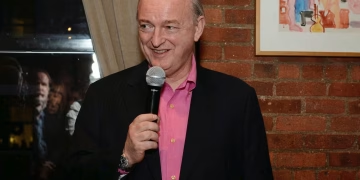
That episode validated a warning Mistral CEO Arthur Mensch has been sounding for over a year. As Business Insider reported, Mensch warned at London Tech Week in June 2025 about American AI companies «having the keys» for their models, calling it a scenario where European companies are «giving leverage to their providers.» He added: «At some point, you need to be able to turn it off or turn it on, and you don’t want to leave it to another country.»
The argument gained further urgency as Mensch’s broader sovereignty pitch escalated in recent months. As reported by CNBC in late May, Mensch told the outlet: «Europe is lagging behind when it comes to [the] buildout of infrastructure, and so we are investing to close that gap.»
At the same time, Mensch pushed back against Pope Leo XIV’s call for AI to be «disarmed,» arguing that Europe cannot afford to fall behind U.S. tech giants. «We’re all for peace, but if you look at our rivals and adversaries in the world, they’re using artificial intelligence … we do need to have our own capabilities,» Mensch told reporters.
OCR 4’s single-container, self-hosted deployment model is the product-level expression of that argument. A U.S.-headquartered provider offering EU data residency means documents are stored in Frankfurt but governed by U.S. law. Mistral, incorporated in France and operating under EU jurisdiction, offering on-premise containerized deployment, means documents never leave the customer’s infrastructure at all. The EU AI Act’s fine enforcement provisions take effect August 2, adding regulatory pressure to the compliance calculus for European enterprises evaluating document AI vendors.

Baidu’s free, open-weight OCR model arrived one day earlier — and the contrast is revealing
Mistral’s release did not arrive in isolation. Just one day before OCR 4 launched, Baidu shipped Unlimited-OCR on June 22 — a 3-billion-parameter MIT-licensed model that tackles one of the most persistent pain points in document AI: parsing entire PDFs and multi-page scans in a single forward pass, without chunking the input or stitching the output back together afterward.
Baidu’s model uses a technique called Reference Sliding Window Attention (R-SWA) that, as a top Hacker News commenter explained, splits the AI’s focus into two paths: maintaining full attention on the original document image while restricting memory of generated text to a tight, moving window. The result is constant KV cache size and the ability to transcribe 40-plus pages in a single forward pass. The model gathered 1,800 GitHub stars in its first 24 hours and racked up more than 479 upvotes on Hacker News, where the discussion thread ran to 109 comments.
The two releases frame what some analysts are calling the June 2026 document-AI split: self-hosted long-horizon parsing with open weights versus structured managed extraction with enterprise features.
Baidu’s model is free under an MIT license, runs on standard GPU hardware, and has no managed API or enterprise SLA. Mistral’s model is a commercial product with per-page pricing, bounding boxes, confidence scores, block classification, multi-platform distribution, and self-hosted deployment options for enterprise customers.
Unlimited-OCR may be the better tool for a research team digitizing scanned dissertations on a single GPU. OCR 4 is built for the IT procurement process — the world of SLAs, data processing agreements, and compliance audits.
Beyond Baidu, the broader OCR competitive field includes Google Document AI, Amazon Textract, Azure Document Intelligence, ABBYY Vantage, and a growing number of open-weight models.
On the Hacker News thread for Unlimited-OCR, practitioners offered a candid assessment of the state of the art. Joss82, who has worked on document parsing for 10 years, wrote bluntly: «OCR still sucks in 2026.» Meanwhile, one user named SyneRyder reported success with Claude for OCR of hundreds of pages of handwritten documents, noting the model delivered results with «no corrections required» and even pointed out a continuity error in the source text. These practitioner reports underscore a key tension in the market: performance varies wildly depending on the specific document type, language, and quality of the source material.
The real play is not OCR — it is an enterprise AI stack with document intelligence as the on-ramp
Step back far enough, and Mistral’s OCR 4 release is not really an OCR story. It is an enterprise go-to-market story built on top of a $4.4 billion global intelligent document processing market that is forecast to grow at a 33.1% compound annual growth rate through 2030, according to Grand View Research.
For Mistral, OCR is a wedge into enterprise AI budgets. The model feeds directly into Mistral’s Search Toolkit, the company’s open-source composable search framework announced at the AI Now Summit. In that architecture, OCR 4 serves as the ingestion layer for retrieval-augmented generation and enterprise search pipelines, converting raw documents into citation-ready, structurally classified input. The logic is clear: once an enterprise adopts OCR 4 for document extraction, Mistral’s broader model suite — including Medium 3.5 for reasoning and the Vibe agentic platform for task execution — becomes the natural next step in the stack.

That pipeline ambition is critical context for understanding Mistral’s current fundraising trajectory. Bloomberg recently reported that the company is in early discussions to raise about €3 billion ($3.5 billion) at a valuation of roughly €20 billion — nearly double the €11.7 billion valuation from its September Series C round. To date, Mistral has raised only about $4 billion, a fraction of what its largest U.S. rivals have taken in. OCR 4 and its associated enterprise revenue pipeline are part of how the company plans to justify that higher valuation, with Mistral targeting €1 billion in revenue for 2026, up from €200 million in 2025, according to Le Monde.
Mistral is a company with roughly 1,000 employees and ambitions to compete with labs that have raised 40 times as much capital. It cannot win a general-purpose model arms race against OpenAI and Anthropic. What it can do is build a differentiated enterprise stack around sovereignty, structured document intelligence, and agentic workflows — and use that stack to capture European enterprise budgets that are increasingly wary of U.S. provider dependency.
The pricing structure reinforces that strategy: at $2 per 1,000 pages in batch mode, the cost of processing a 100,000-page corporate archive falls to $200, making large-scale digitization projects economically viable in ways they may not have been with token-based vision-language model pricing.
Whether Mistral can execute that vision at scale — against Google, Amazon, Microsoft, and a surging open-source ecosystem — remains an open question. But the Anthropic export control crisis is still unresolved, European data sovereignty regulations are tightening, and a potential €20 billion funding round is on the horizon. The company is holding an OCR 4 production webinar on July 7 at 6:00 PM CET.
Two weeks ago, the argument for building AI infrastructure outside the reach of U.S. export controls was theoretical. Then the U.S. government flipped a switch, and Anthropic’s most advanced models went dark for every non-American on the planet. Mistral did not cause that crisis — but it spent the last year building the product that makes it matter.

Mistral AI on Tuesday released OCR 4, a document intelligence model that moves beyond raw text extraction to return structured representations of entire documents — complete with bounding boxes, block-type classification, and per-word confidence scores. The release marks Mistral’s fourth generation of optical character recognition technology in roughly 15 months and lands at a moment when the company’s pitch for European AI sovereignty has never been more commercially relevant.
The model supports 170 languages across 10 language groups, accepts PDF, DOC, PPT, and OpenDocument formats, and can be deployed as a single container on an organization’s own infrastructure — a capability Mistral is positioning directly at enterprises in regulated industries that cannot route sensitive documents through U.S.-jurisdiction cloud APIs.
«Mistral OCR 4 extracts and structures content from a wide range of documents,» the company said in its announcement. «Where previous generations focused on converting a page into clean text and tables, OCR 4 returns a structured representation of the document.»
The model is available immediately through the Mistral API, Document AI in Mistral Studio, Amazon SageMaker, and Microsoft Foundry, with Snowflake Parse Document support coming soon. Pricing starts at $4 per 1,000 pages, dropping to $2 per 1,000 pages through a batch API discount.
OCR 4 treats every document as a semantic map, not a wall of text
The central engineering shift in OCR 4 is structural. Rather than outputting a flat stream of extracted text — the paradigm that has defined OCR for decades — the model returns a layered representation in which every block is localized with a bounding box, classified by type (title, table, equation, signature, and others), and scored for confidence at both the page and word level.
Mistral says bounding boxes were its most-requested capability. The reason is straightforward: without location data, downstream systems cannot trace an extracted fact back to its source on a specific page. That traceability gap has been a persistent friction point for enterprises building retrieval-augmented generation (RAG) pipelines, compliance workflows, or any application where «where did this number come from?» is a question that needs an auditable answer.
Block classification addresses a related problem. A paragraph tagged as a «title» can segment a document into hierarchical chunks for semantic search. A block tagged as a «table» can be routed to a structured-data pipeline rather than a text summarizer. A block tagged as a «signature» can trigger a redaction workflow in a compliance system.
These are not novel ideas in isolation, but packaging them as first-class outputs of the OCR model itself — rather than requiring a separate layout-analysis stage — removes an integration layer that enterprise teams have historically had to build and maintain themselves.
The confidence scores serve a dual purpose. At scale, they allow organizations to programmatically route low-confidence regions to human reviewers and auto-approve high-confidence extractions, building what the industry calls human-in-the-loop verification without requiring a person to review every page of every document. In production systems, OCR is rarely the end goal — it is the first step in a larger pipeline.
Developers building RAG systems, agent workflows, or document automation often spend more time reconstructing layout and structure than on the downstream AI logic itself. OCR 4 aims to eliminate that reconstruction step, and if it delivers on that promise, the value accrues not just in OCR cost savings but in reduced engineering hours across the entire document pipeline.
Independent reviewers preferred Mistral’s output 72 percent of the time, but benchmarks tell a complicated story
Mistral reports that OCR 4 achieved a 72% average win rate in a head-to-head human evaluation against leading competitors, conducted by independent annotators across more than 600 real-world documents in over 12 languages. The model also achieved the top overall score on OlmOCRBench at 85.20 and scored 93.07 on OmniDocBench.
But the company itself urges caution in interpreting those numbers. In its release, Mistral took the unusual step of auditing and publicly disclosing the specific types of scoring artifacts it encountered, including ground-truth errors in the reference annotations, equivalent LaTeX notation scored as mismatches, column-reading-order assumptions, and header/footer attribution issues. «We therefore treat the aggregate score as directional rather than definitive,» the company said — a notably transparent stance from a vendor announcing a product.
That transparency is well-timed. On the public OlmOCRBench leaderboard, some researchers have noted that OCR 4 currently ranks third, behind open models like Chandra OCR 2. And some open-weight models self-report higher OmniDocBench composite scores — PaddleOCR-VL-1.6 claims 96.33 — though those results have not been independently reproduced on the public leaderboard.
Early enterprise feedback has been favorable nonetheless. Aidan Donohue, an AI engineer at financial AI firm Rogo, said the company benchmarked OCR 4 against leading agentic document parsers on a chart-dense financial QA dataset and «reached equivalent accuracy at roughly 8x lower cost and 17x lower latency.» Ivan Mihailov, an AI engineer at intellectual property management firm Anaqua, said OCR 4 is «roughly 4x faster per page than our incumbent provider.»
Enterprise buyers, however, should run their own evaluations rather than relying on any vendor’s benchmark numbers. The practical question is not which model scores highest on a leaderboard, but which model produces the fewest errors on your specific documents, in your specific languages, at a price and latency that fit your workflow.
The Anthropic export ban gave Mistral’s sovereignty pitch the proof point it needed
Mistral’s release lands in a geopolitical context that could hardly be more favorable for its strategic positioning.
On June 12, Anthropic was forced to disable all access to its newest AI models, Fable 5 and Mythos 5, after the U.S. Commerce Department used national security export controls to bar the company from distributing the models to any foreign national. Enterprise clients in finance, healthcare, SaaS, and critical infrastructure found their core intelligence services abruptly disabled, without prior warning or effective recourse. As of June 24, both models remain offline, with prediction markets giving only 57% odds of restoration before July 1.
That episode validated a warning Mistral CEO Arthur Mensch has been sounding for over a year. As Business Insider reported, Mensch warned at London Tech Week in June 2025 about American AI companies «having the keys» for their models, calling it a scenario where European companies are «giving leverage to their providers.» He added: «At some point, you need to be able to turn it off or turn it on, and you don’t want to leave it to another country.»
The argument gained further urgency as Mensch’s broader sovereignty pitch escalated in recent months. As reported by CNBC in late May, Mensch told the outlet: «Europe is lagging behind when it comes to [the] buildout of infrastructure, and so we are investing to close that gap.»
At the same time, Mensch pushed back against Pope Leo XIV’s call for AI to be «disarmed,» arguing that Europe cannot afford to fall behind U.S. tech giants. «We’re all for peace, but if you look at our rivals and adversaries in the world, they’re using artificial intelligence … we do need to have our own capabilities,» Mensch told reporters.
OCR 4’s single-container, self-hosted deployment model is the product-level expression of that argument. A U.S.-headquartered provider offering EU data residency means documents are stored in Frankfurt but governed by U.S. law. Mistral, incorporated in France and operating under EU jurisdiction, offering on-premise containerized deployment, means documents never leave the customer’s infrastructure at all. The EU AI Act’s fine enforcement provisions take effect August 2, adding regulatory pressure to the compliance calculus for European enterprises evaluating document AI vendors.
Baidu’s free, open-weight OCR model arrived one day earlier — and the contrast is revealing
Mistral’s release did not arrive in isolation. Just one day before OCR 4 launched, Baidu shipped Unlimited-OCR on June 22 — a 3-billion-parameter MIT-licensed model that tackles one of the most persistent pain points in document AI: parsing entire PDFs and multi-page scans in a single forward pass, without chunking the input or stitching the output back together afterward.
Baidu’s model uses a technique called Reference Sliding Window Attention (R-SWA) that, as a top Hacker News commenter explained, splits the AI’s focus into two paths: maintaining full attention on the original document image while restricting memory of generated text to a tight, moving window. The result is constant KV cache size and the ability to transcribe 40-plus pages in a single forward pass. The model gathered 1,800 GitHub stars in its first 24 hours and racked up more than 479 upvotes on Hacker News, where the discussion thread ran to 109 comments.
The two releases frame what some analysts are calling the June 2026 document-AI split: self-hosted long-horizon parsing with open weights versus structured managed extraction with enterprise features.
Baidu’s model is free under an MIT license, runs on standard GPU hardware, and has no managed API or enterprise SLA. Mistral’s model is a commercial product with per-page pricing, bounding boxes, confidence scores, block classification, multi-platform distribution, and self-hosted deployment options for enterprise customers.
Unlimited-OCR may be the better tool for a research team digitizing scanned dissertations on a single GPU. OCR 4 is built for the IT procurement process — the world of SLAs, data processing agreements, and compliance audits.
Beyond Baidu, the broader OCR competitive field includes Google Document AI, Amazon Textract, Azure Document Intelligence, ABBYY Vantage, and a growing number of open-weight models.
On the Hacker News thread for Unlimited-OCR, practitioners offered a candid assessment of the state of the art. Joss82, who has worked on document parsing for 10 years, wrote bluntly: «OCR still sucks in 2026.» Meanwhile, one user named SyneRyder reported success with Claude for OCR of hundreds of pages of handwritten documents, noting the model delivered results with «no corrections required» and even pointed out a continuity error in the source text. These practitioner reports underscore a key tension in the market: performance varies wildly depending on the specific document type, language, and quality of the source material.
The real play is not OCR — it is an enterprise AI stack with document intelligence as the on-ramp
Step back far enough, and Mistral’s OCR 4 release is not really an OCR story. It is an enterprise go-to-market story built on top of a $4.4 billion global intelligent document processing market that is forecast to grow at a 33.1% compound annual growth rate through 2030, according to Grand View Research.
For Mistral, OCR is a wedge into enterprise AI budgets. The model feeds directly into Mistral’s Search Toolkit, the company’s open-source composable search framework announced at the AI Now Summit. In that architecture, OCR 4 serves as the ingestion layer for retrieval-augmented generation and enterprise search pipelines, converting raw documents into citation-ready, structurally classified input. The logic is clear: once an enterprise adopts OCR 4 for document extraction, Mistral’s broader model suite — including Medium 3.5 for reasoning and the Vibe agentic platform for task execution — becomes the natural next step in the stack.
That pipeline ambition is critical context for understanding Mistral’s current fundraising trajectory. Bloomberg recently reported that the company is in early discussions to raise about €3 billion ($3.5 billion) at a valuation of roughly €20 billion — nearly double the €11.7 billion valuation from its September Series C round. To date, Mistral has raised only about $4 billion, a fraction of what its largest U.S. rivals have taken in. OCR 4 and its associated enterprise revenue pipeline are part of how the company plans to justify that higher valuation, with Mistral targeting €1 billion in revenue for 2026, up from €200 million in 2025, according to Le Monde.
Mistral is a company with roughly 1,000 employees and ambitions to compete with labs that have raised 40 times as much capital. It cannot win a general-purpose model arms race against OpenAI and Anthropic. What it can do is build a differentiated enterprise stack around sovereignty, structured document intelligence, and agentic workflows — and use that stack to capture European enterprise budgets that are increasingly wary of U.S. provider dependency.
The pricing structure reinforces that strategy: at $2 per 1,000 pages in batch mode, the cost of processing a 100,000-page corporate archive falls to $200, making large-scale digitization projects economically viable in ways they may not have been with token-based vision-language model pricing.
Whether Mistral can execute that vision at scale — against Google, Amazon, Microsoft, and a surging open-source ecosystem — remains an open question. But the Anthropic export control crisis is still unresolved, European data sovereignty regulations are tightening, and a potential €20 billion funding round is on the horizon. The company is holding an OCR 4 production webinar on July 7 at 6:00 PM CET.
Two weeks ago, the argument for building AI infrastructure outside the reach of U.S. export controls was theoretical. Then the U.S. government flipped a switch, and Anthropic’s most advanced models went dark for every non-American on the planet. Mistral did not cause that crisis — but it spent the last year building the product that makes it matter.

Mistral AI on Tuesday released OCR 4, a document intelligence model that moves beyond raw text extraction to return structured representations of entire documents — complete with bounding boxes, block-type classification, and per-word confidence scores. The release marks Mistral’s fourth generation of optical character recognition technology in roughly 15 months and lands at a moment when the company’s pitch for European AI sovereignty has never been more commercially relevant.
The model supports 170 languages across 10 language groups, accepts PDF, DOC, PPT, and OpenDocument formats, and can be deployed as a single container on an organization’s own infrastructure — a capability Mistral is positioning directly at enterprises in regulated industries that cannot route sensitive documents through U.S.-jurisdiction cloud APIs.
«Mistral OCR 4 extracts and structures content from a wide range of documents,» the company said in its announcement. «Where previous generations focused on converting a page into clean text and tables, OCR 4 returns a structured representation of the document.»
The model is available immediately through the Mistral API, Document AI in Mistral Studio, Amazon SageMaker, and Microsoft Foundry, with Snowflake Parse Document support coming soon. Pricing starts at $4 per 1,000 pages, dropping to $2 per 1,000 pages through a batch API discount.
OCR 4 treats every document as a semantic map, not a wall of text
The central engineering shift in OCR 4 is structural. Rather than outputting a flat stream of extracted text — the paradigm that has defined OCR for decades — the model returns a layered representation in which every block is localized with a bounding box, classified by type (title, table, equation, signature, and others), and scored for confidence at both the page and word level.
Mistral says bounding boxes were its most-requested capability. The reason is straightforward: without location data, downstream systems cannot trace an extracted fact back to its source on a specific page. That traceability gap has been a persistent friction point for enterprises building retrieval-augmented generation (RAG) pipelines, compliance workflows, or any application where «where did this number come from?» is a question that needs an auditable answer.
Block classification addresses a related problem. A paragraph tagged as a «title» can segment a document into hierarchical chunks for semantic search. A block tagged as a «table» can be routed to a structured-data pipeline rather than a text summarizer. A block tagged as a «signature» can trigger a redaction workflow in a compliance system.
These are not novel ideas in isolation, but packaging them as first-class outputs of the OCR model itself — rather than requiring a separate layout-analysis stage — removes an integration layer that enterprise teams have historically had to build and maintain themselves.
The confidence scores serve a dual purpose. At scale, they allow organizations to programmatically route low-confidence regions to human reviewers and auto-approve high-confidence extractions, building what the industry calls human-in-the-loop verification without requiring a person to review every page of every document. In production systems, OCR is rarely the end goal — it is the first step in a larger pipeline.
Developers building RAG systems, agent workflows, or document automation often spend more time reconstructing layout and structure than on the downstream AI logic itself. OCR 4 aims to eliminate that reconstruction step, and if it delivers on that promise, the value accrues not just in OCR cost savings but in reduced engineering hours across the entire document pipeline.
Independent reviewers preferred Mistral’s output 72 percent of the time, but benchmarks tell a complicated story
Mistral reports that OCR 4 achieved a 72% average win rate in a head-to-head human evaluation against leading competitors, conducted by independent annotators across more than 600 real-world documents in over 12 languages. The model also achieved the top overall score on OlmOCRBench at 85.20 and scored 93.07 on OmniDocBench.
But the company itself urges caution in interpreting those numbers. In its release, Mistral took the unusual step of auditing and publicly disclosing the specific types of scoring artifacts it encountered, including ground-truth errors in the reference annotations, equivalent LaTeX notation scored as mismatches, column-reading-order assumptions, and header/footer attribution issues. «We therefore treat the aggregate score as directional rather than definitive,» the company said — a notably transparent stance from a vendor announcing a product.
That transparency is well-timed. On the public OlmOCRBench leaderboard, some researchers have noted that OCR 4 currently ranks third, behind open models like Chandra OCR 2. And some open-weight models self-report higher OmniDocBench composite scores — PaddleOCR-VL-1.6 claims 96.33 — though those results have not been independently reproduced on the public leaderboard.
Early enterprise feedback has been favorable nonetheless. Aidan Donohue, an AI engineer at financial AI firm Rogo, said the company benchmarked OCR 4 against leading agentic document parsers on a chart-dense financial QA dataset and «reached equivalent accuracy at roughly 8x lower cost and 17x lower latency.» Ivan Mihailov, an AI engineer at intellectual property management firm Anaqua, said OCR 4 is «roughly 4x faster per page than our incumbent provider.»
Enterprise buyers, however, should run their own evaluations rather than relying on any vendor’s benchmark numbers. The practical question is not which model scores highest on a leaderboard, but which model produces the fewest errors on your specific documents, in your specific languages, at a price and latency that fit your workflow.
The Anthropic export ban gave Mistral’s sovereignty pitch the proof point it needed
Mistral’s release lands in a geopolitical context that could hardly be more favorable for its strategic positioning.
On June 12, Anthropic was forced to disable all access to its newest AI models, Fable 5 and Mythos 5, after the U.S. Commerce Department used national security export controls to bar the company from distributing the models to any foreign national. Enterprise clients in finance, healthcare, SaaS, and critical infrastructure found their core intelligence services abruptly disabled, without prior warning or effective recourse. As of June 24, both models remain offline, with prediction markets giving only 57% odds of restoration before July 1.
That episode validated a warning Mistral CEO Arthur Mensch has been sounding for over a year. As Business Insider reported, Mensch warned at London Tech Week in June 2025 about American AI companies «having the keys» for their models, calling it a scenario where European companies are «giving leverage to their providers.» He added: «At some point, you need to be able to turn it off or turn it on, and you don’t want to leave it to another country.»
The argument gained further urgency as Mensch’s broader sovereignty pitch escalated in recent months. As reported by CNBC in late May, Mensch told the outlet: «Europe is lagging behind when it comes to [the] buildout of infrastructure, and so we are investing to close that gap.»
At the same time, Mensch pushed back against Pope Leo XIV’s call for AI to be «disarmed,» arguing that Europe cannot afford to fall behind U.S. tech giants. «We’re all for peace, but if you look at our rivals and adversaries in the world, they’re using artificial intelligence … we do need to have our own capabilities,» Mensch told reporters.
OCR 4’s single-container, self-hosted deployment model is the product-level expression of that argument. A U.S.-headquartered provider offering EU data residency means documents are stored in Frankfurt but governed by U.S. law. Mistral, incorporated in France and operating under EU jurisdiction, offering on-premise containerized deployment, means documents never leave the customer’s infrastructure at all. The EU AI Act’s fine enforcement provisions take effect August 2, adding regulatory pressure to the compliance calculus for European enterprises evaluating document AI vendors.
Baidu’s free, open-weight OCR model arrived one day earlier — and the contrast is revealing
Mistral’s release did not arrive in isolation. Just one day before OCR 4 launched, Baidu shipped Unlimited-OCR on June 22 — a 3-billion-parameter MIT-licensed model that tackles one of the most persistent pain points in document AI: parsing entire PDFs and multi-page scans in a single forward pass, without chunking the input or stitching the output back together afterward.
Baidu’s model uses a technique called Reference Sliding Window Attention (R-SWA) that, as a top Hacker News commenter explained, splits the AI’s focus into two paths: maintaining full attention on the original document image while restricting memory of generated text to a tight, moving window. The result is constant KV cache size and the ability to transcribe 40-plus pages in a single forward pass. The model gathered 1,800 GitHub stars in its first 24 hours and racked up more than 479 upvotes on Hacker News, where the discussion thread ran to 109 comments.
The two releases frame what some analysts are calling the June 2026 document-AI split: self-hosted long-horizon parsing with open weights versus structured managed extraction with enterprise features.
Baidu’s model is free under an MIT license, runs on standard GPU hardware, and has no managed API or enterprise SLA. Mistral’s model is a commercial product with per-page pricing, bounding boxes, confidence scores, block classification, multi-platform distribution, and self-hosted deployment options for enterprise customers.
Unlimited-OCR may be the better tool for a research team digitizing scanned dissertations on a single GPU. OCR 4 is built for the IT procurement process — the world of SLAs, data processing agreements, and compliance audits.
Beyond Baidu, the broader OCR competitive field includes Google Document AI, Amazon Textract, Azure Document Intelligence, ABBYY Vantage, and a growing number of open-weight models.
On the Hacker News thread for Unlimited-OCR, practitioners offered a candid assessment of the state of the art. Joss82, who has worked on document parsing for 10 years, wrote bluntly: «OCR still sucks in 2026.» Meanwhile, one user named SyneRyder reported success with Claude for OCR of hundreds of pages of handwritten documents, noting the model delivered results with «no corrections required» and even pointed out a continuity error in the source text. These practitioner reports underscore a key tension in the market: performance varies wildly depending on the specific document type, language, and quality of the source material.
The real play is not OCR — it is an enterprise AI stack with document intelligence as the on-ramp
Step back far enough, and Mistral’s OCR 4 release is not really an OCR story. It is an enterprise go-to-market story built on top of a $4.4 billion global intelligent document processing market that is forecast to grow at a 33.1% compound annual growth rate through 2030, according to Grand View Research.
For Mistral, OCR is a wedge into enterprise AI budgets. The model feeds directly into Mistral’s Search Toolkit, the company’s open-source composable search framework announced at the AI Now Summit. In that architecture, OCR 4 serves as the ingestion layer for retrieval-augmented generation and enterprise search pipelines, converting raw documents into citation-ready, structurally classified input. The logic is clear: once an enterprise adopts OCR 4 for document extraction, Mistral’s broader model suite — including Medium 3.5 for reasoning and the Vibe agentic platform for task execution — becomes the natural next step in the stack.
That pipeline ambition is critical context for understanding Mistral’s current fundraising trajectory. Bloomberg recently reported that the company is in early discussions to raise about €3 billion ($3.5 billion) at a valuation of roughly €20 billion — nearly double the €11.7 billion valuation from its September Series C round. To date, Mistral has raised only about $4 billion, a fraction of what its largest U.S. rivals have taken in. OCR 4 and its associated enterprise revenue pipeline are part of how the company plans to justify that higher valuation, with Mistral targeting €1 billion in revenue for 2026, up from €200 million in 2025, according to Le Monde.
Mistral is a company with roughly 1,000 employees and ambitions to compete with labs that have raised 40 times as much capital. It cannot win a general-purpose model arms race against OpenAI and Anthropic. What it can do is build a differentiated enterprise stack around sovereignty, structured document intelligence, and agentic workflows — and use that stack to capture European enterprise budgets that are increasingly wary of U.S. provider dependency.
The pricing structure reinforces that strategy: at $2 per 1,000 pages in batch mode, the cost of processing a 100,000-page corporate archive falls to $200, making large-scale digitization projects economically viable in ways they may not have been with token-based vision-language model pricing.
Whether Mistral can execute that vision at scale — against Google, Amazon, Microsoft, and a surging open-source ecosystem — remains an open question. But the Anthropic export control crisis is still unresolved, European data sovereignty regulations are tightening, and a potential €20 billion funding round is on the horizon. The company is holding an OCR 4 production webinar on July 7 at 6:00 PM CET.
Two weeks ago, the argument for building AI infrastructure outside the reach of U.S. export controls was theoretical. Then the U.S. government flipped a switch, and Anthropic’s most advanced models went dark for every non-American on the planet. Mistral did not cause that crisis — but it spent the last year building the product that makes it matter.
Mistral AI on Tuesday released OCR 4, a document intelligence model that moves beyond raw text extraction to return structured representations of entire documents — complete with bounding boxes, block-type classification, and per-word confidence scores. The release marks Mistral’s fourth generation of optical character recognition technology in roughly 15 months and lands at a moment when the company’s pitch for European AI sovereignty has never been more commercially relevant.
The model supports 170 languages across 10 language groups, accepts PDF, DOC, PPT, and OpenDocument formats, and can be deployed as a single container on an organization’s own infrastructure — a capability Mistral is positioning directly at enterprises in regulated industries that cannot route sensitive documents through U.S.-jurisdiction cloud APIs.
«Mistral OCR 4 extracts and structures content from a wide range of documents,» the company said in its announcement. «Where previous generations focused on converting a page into clean text and tables, OCR 4 returns a structured representation of the document.»
The model is available immediately through the Mistral API, Document AI in Mistral Studio, Amazon SageMaker, and Microsoft Foundry, with Snowflake Parse Document support coming soon. Pricing starts at $4 per 1,000 pages, dropping to $2 per 1,000 pages through a batch API discount.
OCR 4 treats every document as a semantic map, not a wall of text
The central engineering shift in OCR 4 is structural. Rather than outputting a flat stream of extracted text — the paradigm that has defined OCR for decades — the model returns a layered representation in which every block is localized with a bounding box, classified by type (title, table, equation, signature, and others), and scored for confidence at both the page and word level.
Mistral says bounding boxes were its most-requested capability. The reason is straightforward: without location data, downstream systems cannot trace an extracted fact back to its source on a specific page. That traceability gap has been a persistent friction point for enterprises building retrieval-augmented generation (RAG) pipelines, compliance workflows, or any application where «where did this number come from?» is a question that needs an auditable answer.
Block classification addresses a related problem. A paragraph tagged as a «title» can segment a document into hierarchical chunks for semantic search. A block tagged as a «table» can be routed to a structured-data pipeline rather than a text summarizer. A block tagged as a «signature» can trigger a redaction workflow in a compliance system.
These are not novel ideas in isolation, but packaging them as first-class outputs of the OCR model itself — rather than requiring a separate layout-analysis stage — removes an integration layer that enterprise teams have historically had to build and maintain themselves.
The confidence scores serve a dual purpose. At scale, they allow organizations to programmatically route low-confidence regions to human reviewers and auto-approve high-confidence extractions, building what the industry calls human-in-the-loop verification without requiring a person to review every page of every document. In production systems, OCR is rarely the end goal — it is the first step in a larger pipeline.
Developers building RAG systems, agent workflows, or document automation often spend more time reconstructing layout and structure than on the downstream AI logic itself. OCR 4 aims to eliminate that reconstruction step, and if it delivers on that promise, the value accrues not just in OCR cost savings but in reduced engineering hours across the entire document pipeline.
Independent reviewers preferred Mistral’s output 72 percent of the time, but benchmarks tell a complicated story
Mistral reports that OCR 4 achieved a 72% average win rate in a head-to-head human evaluation against leading competitors, conducted by independent annotators across more than 600 real-world documents in over 12 languages. The model also achieved the top overall score on OlmOCRBench at 85.20 and scored 93.07 on OmniDocBench.
But the company itself urges caution in interpreting those numbers. In its release, Mistral took the unusual step of auditing and publicly disclosing the specific types of scoring artifacts it encountered, including ground-truth errors in the reference annotations, equivalent LaTeX notation scored as mismatches, column-reading-order assumptions, and header/footer attribution issues. «We therefore treat the aggregate score as directional rather than definitive,» the company said — a notably transparent stance from a vendor announcing a product.
That transparency is well-timed. On the public OlmOCRBench leaderboard, some researchers have noted that OCR 4 currently ranks third, behind open models like Chandra OCR 2. And some open-weight models self-report higher OmniDocBench composite scores — PaddleOCR-VL-1.6 claims 96.33 — though those results have not been independently reproduced on the public leaderboard.
Early enterprise feedback has been favorable nonetheless. Aidan Donohue, an AI engineer at financial AI firm Rogo, said the company benchmarked OCR 4 against leading agentic document parsers on a chart-dense financial QA dataset and «reached equivalent accuracy at roughly 8x lower cost and 17x lower latency.» Ivan Mihailov, an AI engineer at intellectual property management firm Anaqua, said OCR 4 is «roughly 4x faster per page than our incumbent provider.»
Enterprise buyers, however, should run their own evaluations rather than relying on any vendor’s benchmark numbers. The practical question is not which model scores highest on a leaderboard, but which model produces the fewest errors on your specific documents, in your specific languages, at a price and latency that fit your workflow.
The Anthropic export ban gave Mistral’s sovereignty pitch the proof point it needed
Mistral’s release lands in a geopolitical context that could hardly be more favorable for its strategic positioning.
On June 12, Anthropic was forced to disable all access to its newest AI models, Fable 5 and Mythos 5, after the U.S. Commerce Department used national security export controls to bar the company from distributing the models to any foreign national. Enterprise clients in finance, healthcare, SaaS, and critical infrastructure found their core intelligence services abruptly disabled, without prior warning or effective recourse. As of June 24, both models remain offline, with prediction markets giving only 57% odds of restoration before July 1.
That episode validated a warning Mistral CEO Arthur Mensch has been sounding for over a year. As Business Insider reported, Mensch warned at London Tech Week in June 2025 about American AI companies «having the keys» for their models, calling it a scenario where European companies are «giving leverage to their providers.» He added: «At some point, you need to be able to turn it off or turn it on, and you don’t want to leave it to another country.»
The argument gained further urgency as Mensch’s broader sovereignty pitch escalated in recent months. As reported by CNBC in late May, Mensch told the outlet: «Europe is lagging behind when it comes to [the] buildout of infrastructure, and so we are investing to close that gap.»
At the same time, Mensch pushed back against Pope Leo XIV’s call for AI to be «disarmed,» arguing that Europe cannot afford to fall behind U.S. tech giants. «We’re all for peace, but if you look at our rivals and adversaries in the world, they’re using artificial intelligence … we do need to have our own capabilities,» Mensch told reporters.
OCR 4’s single-container, self-hosted deployment model is the product-level expression of that argument. A U.S.-headquartered provider offering EU data residency means documents are stored in Frankfurt but governed by U.S. law. Mistral, incorporated in France and operating under EU jurisdiction, offering on-premise containerized deployment, means documents never leave the customer’s infrastructure at all. The EU AI Act’s fine enforcement provisions take effect August 2, adding regulatory pressure to the compliance calculus for European enterprises evaluating document AI vendors.
Baidu’s free, open-weight OCR model arrived one day earlier — and the contrast is revealing
Mistral’s release did not arrive in isolation. Just one day before OCR 4 launched, Baidu shipped Unlimited-OCR on June 22 — a 3-billion-parameter MIT-licensed model that tackles one of the most persistent pain points in document AI: parsing entire PDFs and multi-page scans in a single forward pass, without chunking the input or stitching the output back together afterward.
Baidu’s model uses a technique called Reference Sliding Window Attention (R-SWA) that, as a top Hacker News commenter explained, splits the AI’s focus into two paths: maintaining full attention on the original document image while restricting memory of generated text to a tight, moving window. The result is constant KV cache size and the ability to transcribe 40-plus pages in a single forward pass. The model gathered 1,800 GitHub stars in its first 24 hours and racked up more than 479 upvotes on Hacker News, where the discussion thread ran to 109 comments.
The two releases frame what some analysts are calling the June 2026 document-AI split: self-hosted long-horizon parsing with open weights versus structured managed extraction with enterprise features.
Baidu’s model is free under an MIT license, runs on standard GPU hardware, and has no managed API or enterprise SLA. Mistral’s model is a commercial product with per-page pricing, bounding boxes, confidence scores, block classification, multi-platform distribution, and self-hosted deployment options for enterprise customers.
Unlimited-OCR may be the better tool for a research team digitizing scanned dissertations on a single GPU. OCR 4 is built for the IT procurement process — the world of SLAs, data processing agreements, and compliance audits.
Beyond Baidu, the broader OCR competitive field includes Google Document AI, Amazon Textract, Azure Document Intelligence, ABBYY Vantage, and a growing number of open-weight models.
On the Hacker News thread for Unlimited-OCR, practitioners offered a candid assessment of the state of the art. Joss82, who has worked on document parsing for 10 years, wrote bluntly: «OCR still sucks in 2026.» Meanwhile, one user named SyneRyder reported success with Claude for OCR of hundreds of pages of handwritten documents, noting the model delivered results with «no corrections required» and even pointed out a continuity error in the source text. These practitioner reports underscore a key tension in the market: performance varies wildly depending on the specific document type, language, and quality of the source material.
The real play is not OCR — it is an enterprise AI stack with document intelligence as the on-ramp
Step back far enough, and Mistral’s OCR 4 release is not really an OCR story. It is an enterprise go-to-market story built on top of a $4.4 billion global intelligent document processing market that is forecast to grow at a 33.1% compound annual growth rate through 2030, according to Grand View Research.
For Mistral, OCR is a wedge into enterprise AI budgets. The model feeds directly into Mistral’s Search Toolkit, the company’s open-source composable search framework announced at the AI Now Summit. In that architecture, OCR 4 serves as the ingestion layer for retrieval-augmented generation and enterprise search pipelines, converting raw documents into citation-ready, structurally classified input. The logic is clear: once an enterprise adopts OCR 4 for document extraction, Mistral’s broader model suite — including Medium 3.5 for reasoning and the Vibe agentic platform for task execution — becomes the natural next step in the stack.
That pipeline ambition is critical context for understanding Mistral’s current fundraising trajectory. Bloomberg recently reported that the company is in early discussions to raise about €3 billion ($3.5 billion) at a valuation of roughly €20 billion — nearly double the €11.7 billion valuation from its September Series C round. To date, Mistral has raised only about $4 billion, a fraction of what its largest U.S. rivals have taken in. OCR 4 and its associated enterprise revenue pipeline are part of how the company plans to justify that higher valuation, with Mistral targeting €1 billion in revenue for 2026, up from €200 million in 2025, according to Le Monde.
Mistral is a company with roughly 1,000 employees and ambitions to compete with labs that have raised 40 times as much capital. It cannot win a general-purpose model arms race against OpenAI and Anthropic. What it can do is build a differentiated enterprise stack around sovereignty, structured document intelligence, and agentic workflows — and use that stack to capture European enterprise budgets that are increasingly wary of U.S. provider dependency.
The pricing structure reinforces that strategy: at $2 per 1,000 pages in batch mode, the cost of processing a 100,000-page corporate archive falls to $200, making large-scale digitization projects economically viable in ways they may not have been with token-based vision-language model pricing.
Whether Mistral can execute that vision at scale — against Google, Amazon, Microsoft, and a surging open-source ecosystem — remains an open question. But the Anthropic export control crisis is still unresolved, European data sovereignty regulations are tightening, and a potential €20 billion funding round is on the horizon. The company is holding an OCR 4 production webinar on July 7 at 6:00 PM CET.
Two weeks ago, the argument for building AI infrastructure outside the reach of U.S. export controls was theoretical. Then the U.S. government flipped a switch, and Anthropic’s most advanced models went dark for every non-American on the planet. Mistral did not cause that crisis — but it spent the last year building the product that makes it matter.
Suscríbete y recibe las historias más importantes del día.
Al suscribirte aceptas nuestros términos y condiciones y política de privacidad.
Mistral AI on Tuesday released OCR 4, a document intelligence model that moves beyond raw text extraction to return structured representations of entire documents — complete with bounding boxes, block-type classification, and per-word confidence scores. The release marks Mistral’s fourth generation of optical character recognition technology in roughly 15 months and lands at a moment when the company’s pitch for European AI sovereignty has never been more commercially relevant.
The model supports 170 languages across 10 language groups, accepts PDF, DOC, PPT, and OpenDocument formats, and can be deployed as a single container on an organization’s own infrastructure — a capability Mistral is positioning directly at enterprises in regulated industries that cannot route sensitive documents through U.S.-jurisdiction cloud APIs.
«Mistral OCR 4 extracts and structures content from a wide range of documents,» the company said in its announcement. «Where previous generations focused on converting a page into clean text and tables, OCR 4 returns a structured representation of the document.»
The model is available immediately through the Mistral API, Document AI in Mistral Studio, Amazon SageMaker, and Microsoft Foundry, with Snowflake Parse Document support coming soon. Pricing starts at $4 per 1,000 pages, dropping to $2 per 1,000 pages through a batch API discount.
OCR 4 treats every document as a semantic map, not a wall of text
The central engineering shift in OCR 4 is structural. Rather than outputting a flat stream of extracted text — the paradigm that has defined OCR for decades — the model returns a layered representation in which every block is localized with a bounding box, classified by type (title, table, equation, signature, and others), and scored for confidence at both the page and word level.
Mistral says bounding boxes were its most-requested capability. The reason is straightforward: without location data, downstream systems cannot trace an extracted fact back to its source on a specific page. That traceability gap has been a persistent friction point for enterprises building retrieval-augmented generation (RAG) pipelines, compliance workflows, or any application where «where did this number come from?» is a question that needs an auditable answer.
Block classification addresses a related problem. A paragraph tagged as a «title» can segment a document into hierarchical chunks for semantic search. A block tagged as a «table» can be routed to a structured-data pipeline rather than a text summarizer. A block tagged as a «signature» can trigger a redaction workflow in a compliance system.
These are not novel ideas in isolation, but packaging them as first-class outputs of the OCR model itself — rather than requiring a separate layout-analysis stage — removes an integration layer that enterprise teams have historically had to build and maintain themselves.
The confidence scores serve a dual purpose. At scale, they allow organizations to programmatically route low-confidence regions to human reviewers and auto-approve high-confidence extractions, building what the industry calls human-in-the-loop verification without requiring a person to review every page of every document. In production systems, OCR is rarely the end goal — it is the first step in a larger pipeline.
Developers building RAG systems, agent workflows, or document automation often spend more time reconstructing layout and structure than on the downstream AI logic itself. OCR 4 aims to eliminate that reconstruction step, and if it delivers on that promise, the value accrues not just in OCR cost savings but in reduced engineering hours across the entire document pipeline.
Independent reviewers preferred Mistral’s output 72 percent of the time, but benchmarks tell a complicated story
Mistral reports that OCR 4 achieved a 72% average win rate in a head-to-head human evaluation against leading competitors, conducted by independent annotators across more than 600 real-world documents in over 12 languages. The model also achieved the top overall score on OlmOCRBench at 85.20 and scored 93.07 on OmniDocBench.
But the company itself urges caution in interpreting those numbers. In its release, Mistral took the unusual step of auditing and publicly disclosing the specific types of scoring artifacts it encountered, including ground-truth errors in the reference annotations, equivalent LaTeX notation scored as mismatches, column-reading-order assumptions, and header/footer attribution issues. «We therefore treat the aggregate score as directional rather than definitive,» the company said — a notably transparent stance from a vendor announcing a product.
That transparency is well-timed. On the public OlmOCRBench leaderboard, some researchers have noted that OCR 4 currently ranks third, behind open models like Chandra OCR 2. And some open-weight models self-report higher OmniDocBench composite scores — PaddleOCR-VL-1.6 claims 96.33 — though those results have not been independently reproduced on the public leaderboard.
Early enterprise feedback has been favorable nonetheless. Aidan Donohue, an AI engineer at financial AI firm Rogo, said the company benchmarked OCR 4 against leading agentic document parsers on a chart-dense financial QA dataset and «reached equivalent accuracy at roughly 8x lower cost and 17x lower latency.» Ivan Mihailov, an AI engineer at intellectual property management firm Anaqua, said OCR 4 is «roughly 4x faster per page than our incumbent provider.»
Enterprise buyers, however, should run their own evaluations rather than relying on any vendor’s benchmark numbers. The practical question is not which model scores highest on a leaderboard, but which model produces the fewest errors on your specific documents, in your specific languages, at a price and latency that fit your workflow.
The Anthropic export ban gave Mistral’s sovereignty pitch the proof point it needed
Mistral’s release lands in a geopolitical context that could hardly be more favorable for its strategic positioning.
On June 12, Anthropic was forced to disable all access to its newest AI models, Fable 5 and Mythos 5, after the U.S. Commerce Department used national security export controls to bar the company from distributing the models to any foreign national. Enterprise clients in finance, healthcare, SaaS, and critical infrastructure found their core intelligence services abruptly disabled, without prior warning or effective recourse. As of June 24, both models remain offline, with prediction markets giving only 57% odds of restoration before July 1.
That episode validated a warning Mistral CEO Arthur Mensch has been sounding for over a year. As Business Insider reported, Mensch warned at London Tech Week in June 2025 about American AI companies «having the keys» for their models, calling it a scenario where European companies are «giving leverage to their providers.» He added: «At some point, you need to be able to turn it off or turn it on, and you don’t want to leave it to another country.»
The argument gained further urgency as Mensch’s broader sovereignty pitch escalated in recent months. As reported by CNBC in late May, Mensch told the outlet: «Europe is lagging behind when it comes to [the] buildout of infrastructure, and so we are investing to close that gap.»
At the same time, Mensch pushed back against Pope Leo XIV’s call for AI to be «disarmed,» arguing that Europe cannot afford to fall behind U.S. tech giants. «We’re all for peace, but if you look at our rivals and adversaries in the world, they’re using artificial intelligence … we do need to have our own capabilities,» Mensch told reporters.
OCR 4’s single-container, self-hosted deployment model is the product-level expression of that argument. A U.S.-headquartered provider offering EU data residency means documents are stored in Frankfurt but governed by U.S. law. Mistral, incorporated in France and operating under EU jurisdiction, offering on-premise containerized deployment, means documents never leave the customer’s infrastructure at all. The EU AI Act’s fine enforcement provisions take effect August 2, adding regulatory pressure to the compliance calculus for European enterprises evaluating document AI vendors.
Baidu’s free, open-weight OCR model arrived one day earlier — and the contrast is revealing
Mistral’s release did not arrive in isolation. Just one day before OCR 4 launched, Baidu shipped Unlimited-OCR on June 22 — a 3-billion-parameter MIT-licensed model that tackles one of the most persistent pain points in document AI: parsing entire PDFs and multi-page scans in a single forward pass, without chunking the input or stitching the output back together afterward.
Baidu’s model uses a technique called Reference Sliding Window Attention (R-SWA) that, as a top Hacker News commenter explained, splits the AI’s focus into two paths: maintaining full attention on the original document image while restricting memory of generated text to a tight, moving window. The result is constant KV cache size and the ability to transcribe 40-plus pages in a single forward pass. The model gathered 1,800 GitHub stars in its first 24 hours and racked up more than 479 upvotes on Hacker News, where the discussion thread ran to 109 comments.
The two releases frame what some analysts are calling the June 2026 document-AI split: self-hosted long-horizon parsing with open weights versus structured managed extraction with enterprise features.
Baidu’s model is free under an MIT license, runs on standard GPU hardware, and has no managed API or enterprise SLA. Mistral’s model is a commercial product with per-page pricing, bounding boxes, confidence scores, block classification, multi-platform distribution, and self-hosted deployment options for enterprise customers.
Unlimited-OCR may be the better tool for a research team digitizing scanned dissertations on a single GPU. OCR 4 is built for the IT procurement process — the world of SLAs, data processing agreements, and compliance audits.
Beyond Baidu, the broader OCR competitive field includes Google Document AI, Amazon Textract, Azure Document Intelligence, ABBYY Vantage, and a growing number of open-weight models.
On the Hacker News thread for Unlimited-OCR, practitioners offered a candid assessment of the state of the art. Joss82, who has worked on document parsing for 10 years, wrote bluntly: «OCR still sucks in 2026.» Meanwhile, one user named SyneRyder reported success with Claude for OCR of hundreds of pages of handwritten documents, noting the model delivered results with «no corrections required» and even pointed out a continuity error in the source text. These practitioner reports underscore a key tension in the market: performance varies wildly depending on the specific document type, language, and quality of the source material.
The real play is not OCR — it is an enterprise AI stack with document intelligence as the on-ramp
Step back far enough, and Mistral’s OCR 4 release is not really an OCR story. It is an enterprise go-to-market story built on top of a $4.4 billion global intelligent document processing market that is forecast to grow at a 33.1% compound annual growth rate through 2030, according to Grand View Research.
For Mistral, OCR is a wedge into enterprise AI budgets. The model feeds directly into Mistral’s Search Toolkit, the company’s open-source composable search framework announced at the AI Now Summit. In that architecture, OCR 4 serves as the ingestion layer for retrieval-augmented generation and enterprise search pipelines, converting raw documents into citation-ready, structurally classified input. The logic is clear: once an enterprise adopts OCR 4 for document extraction, Mistral’s broader model suite — including Medium 3.5 for reasoning and the Vibe agentic platform for task execution — becomes the natural next step in the stack.
That pipeline ambition is critical context for understanding Mistral’s current fundraising trajectory. Bloomberg recently reported that the company is in early discussions to raise about €3 billion ($3.5 billion) at a valuation of roughly €20 billion — nearly double the €11.7 billion valuation from its September Series C round. To date, Mistral has raised only about $4 billion, a fraction of what its largest U.S. rivals have taken in. OCR 4 and its associated enterprise revenue pipeline are part of how the company plans to justify that higher valuation, with Mistral targeting €1 billion in revenue for 2026, up from €200 million in 2025, according to Le Monde.
Mistral is a company with roughly 1,000 employees and ambitions to compete with labs that have raised 40 times as much capital. It cannot win a general-purpose model arms race against OpenAI and Anthropic. What it can do is build a differentiated enterprise stack around sovereignty, structured document intelligence, and agentic workflows — and use that stack to capture European enterprise budgets that are increasingly wary of U.S. provider dependency.
The pricing structure reinforces that strategy: at $2 per 1,000 pages in batch mode, the cost of processing a 100,000-page corporate archive falls to $200, making large-scale digitization projects economically viable in ways they may not have been with token-based vision-language model pricing.
Whether Mistral can execute that vision at scale — against Google, Amazon, Microsoft, and a surging open-source ecosystem — remains an open question. But the Anthropic export control crisis is still unresolved, European data sovereignty regulations are tightening, and a potential €20 billion funding round is on the horizon. The company is holding an OCR 4 production webinar on July 7 at 6:00 PM CET.
Two weeks ago, the argument for building AI infrastructure outside the reach of U.S. export controls was theoretical. Then the U.S. government flipped a switch, and Anthropic’s most advanced models went dark for every non-American on the planet. Mistral did not cause that crisis — but it spent the last year building the product that makes it matter.
Mistral AI on Tuesday released OCR 4, a document intelligence model that moves beyond raw text extraction to return structured representations of entire documents — complete with bounding boxes, block-type classification, and per-word confidence scores. The release marks Mistral’s fourth generation of optical character recognition technology in roughly 15 months and lands at a moment when the company’s pitch for European AI sovereignty has never been more commercially relevant.
The model supports 170 languages across 10 language groups, accepts PDF, DOC, PPT, and OpenDocument formats, and can be deployed as a single container on an organization’s own infrastructure — a capability Mistral is positioning directly at enterprises in regulated industries that cannot route sensitive documents through U.S.-jurisdiction cloud APIs.
«Mistral OCR 4 extracts and structures content from a wide range of documents,» the company said in its announcement. «Where previous generations focused on converting a page into clean text and tables, OCR 4 returns a structured representation of the document.»
The model is available immediately through the Mistral API, Document AI in Mistral Studio, Amazon SageMaker, and Microsoft Foundry, with Snowflake Parse Document support coming soon. Pricing starts at $4 per 1,000 pages, dropping to $2 per 1,000 pages through a batch API discount.
OCR 4 treats every document as a semantic map, not a wall of text
The central engineering shift in OCR 4 is structural. Rather than outputting a flat stream of extracted text — the paradigm that has defined OCR for decades — the model returns a layered representation in which every block is localized with a bounding box, classified by type (title, table, equation, signature, and others), and scored for confidence at both the page and word level.
Mistral says bounding boxes were its most-requested capability. The reason is straightforward: without location data, downstream systems cannot trace an extracted fact back to its source on a specific page. That traceability gap has been a persistent friction point for enterprises building retrieval-augmented generation (RAG) pipelines, compliance workflows, or any application where «where did this number come from?» is a question that needs an auditable answer.
Block classification addresses a related problem. A paragraph tagged as a «title» can segment a document into hierarchical chunks for semantic search. A block tagged as a «table» can be routed to a structured-data pipeline rather than a text summarizer. A block tagged as a «signature» can trigger a redaction workflow in a compliance system.
These are not novel ideas in isolation, but packaging them as first-class outputs of the OCR model itself — rather than requiring a separate layout-analysis stage — removes an integration layer that enterprise teams have historically had to build and maintain themselves.
The confidence scores serve a dual purpose. At scale, they allow organizations to programmatically route low-confidence regions to human reviewers and auto-approve high-confidence extractions, building what the industry calls human-in-the-loop verification without requiring a person to review every page of every document. In production systems, OCR is rarely the end goal — it is the first step in a larger pipeline.
Developers building RAG systems, agent workflows, or document automation often spend more time reconstructing layout and structure than on the downstream AI logic itself. OCR 4 aims to eliminate that reconstruction step, and if it delivers on that promise, the value accrues not just in OCR cost savings but in reduced engineering hours across the entire document pipeline.
Independent reviewers preferred Mistral’s output 72 percent of the time, but benchmarks tell a complicated story
Mistral reports that OCR 4 achieved a 72% average win rate in a head-to-head human evaluation against leading competitors, conducted by independent annotators across more than 600 real-world documents in over 12 languages. The model also achieved the top overall score on OlmOCRBench at 85.20 and scored 93.07 on OmniDocBench.
But the company itself urges caution in interpreting those numbers. In its release, Mistral took the unusual step of auditing and publicly disclosing the specific types of scoring artifacts it encountered, including ground-truth errors in the reference annotations, equivalent LaTeX notation scored as mismatches, column-reading-order assumptions, and header/footer attribution issues. «We therefore treat the aggregate score as directional rather than definitive,» the company said — a notably transparent stance from a vendor announcing a product.
That transparency is well-timed. On the public OlmOCRBench leaderboard, some researchers have noted that OCR 4 currently ranks third, behind open models like Chandra OCR 2. And some open-weight models self-report higher OmniDocBench composite scores — PaddleOCR-VL-1.6 claims 96.33 — though those results have not been independently reproduced on the public leaderboard.
Early enterprise feedback has been favorable nonetheless. Aidan Donohue, an AI engineer at financial AI firm Rogo, said the company benchmarked OCR 4 against leading agentic document parsers on a chart-dense financial QA dataset and «reached equivalent accuracy at roughly 8x lower cost and 17x lower latency.» Ivan Mihailov, an AI engineer at intellectual property management firm Anaqua, said OCR 4 is «roughly 4x faster per page than our incumbent provider.»
Enterprise buyers, however, should run their own evaluations rather than relying on any vendor’s benchmark numbers. The practical question is not which model scores highest on a leaderboard, but which model produces the fewest errors on your specific documents, in your specific languages, at a price and latency that fit your workflow.
The Anthropic export ban gave Mistral’s sovereignty pitch the proof point it needed
Mistral’s release lands in a geopolitical context that could hardly be more favorable for its strategic positioning.
On June 12, Anthropic was forced to disable all access to its newest AI models, Fable 5 and Mythos 5, after the U.S. Commerce Department used national security export controls to bar the company from distributing the models to any foreign national. Enterprise clients in finance, healthcare, SaaS, and critical infrastructure found their core intelligence services abruptly disabled, without prior warning or effective recourse. As of June 24, both models remain offline, with prediction markets giving only 57% odds of restoration before July 1.
That episode validated a warning Mistral CEO Arthur Mensch has been sounding for over a year. As Business Insider reported, Mensch warned at London Tech Week in June 2025 about American AI companies «having the keys» for their models, calling it a scenario where European companies are «giving leverage to their providers.» He added: «At some point, you need to be able to turn it off or turn it on, and you don’t want to leave it to another country.»
The argument gained further urgency as Mensch’s broader sovereignty pitch escalated in recent months. As reported by CNBC in late May, Mensch told the outlet: «Europe is lagging behind when it comes to [the] buildout of infrastructure, and so we are investing to close that gap.»
At the same time, Mensch pushed back against Pope Leo XIV’s call for AI to be «disarmed,» arguing that Europe cannot afford to fall behind U.S. tech giants. «We’re all for peace, but if you look at our rivals and adversaries in the world, they’re using artificial intelligence … we do need to have our own capabilities,» Mensch told reporters.
OCR 4’s single-container, self-hosted deployment model is the product-level expression of that argument. A U.S.-headquartered provider offering EU data residency means documents are stored in Frankfurt but governed by U.S. law. Mistral, incorporated in France and operating under EU jurisdiction, offering on-premise containerized deployment, means documents never leave the customer’s infrastructure at all. The EU AI Act’s fine enforcement provisions take effect August 2, adding regulatory pressure to the compliance calculus for European enterprises evaluating document AI vendors.
Baidu’s free, open-weight OCR model arrived one day earlier — and the contrast is revealing
Mistral’s release did not arrive in isolation. Just one day before OCR 4 launched, Baidu shipped Unlimited-OCR on June 22 — a 3-billion-parameter MIT-licensed model that tackles one of the most persistent pain points in document AI: parsing entire PDFs and multi-page scans in a single forward pass, without chunking the input or stitching the output back together afterward.
Baidu’s model uses a technique called Reference Sliding Window Attention (R-SWA) that, as a top Hacker News commenter explained, splits the AI’s focus into two paths: maintaining full attention on the original document image while restricting memory of generated text to a tight, moving window. The result is constant KV cache size and the ability to transcribe 40-plus pages in a single forward pass. The model gathered 1,800 GitHub stars in its first 24 hours and racked up more than 479 upvotes on Hacker News, where the discussion thread ran to 109 comments.
The two releases frame what some analysts are calling the June 2026 document-AI split: self-hosted long-horizon parsing with open weights versus structured managed extraction with enterprise features.
Baidu’s model is free under an MIT license, runs on standard GPU hardware, and has no managed API or enterprise SLA. Mistral’s model is a commercial product with per-page pricing, bounding boxes, confidence scores, block classification, multi-platform distribution, and self-hosted deployment options for enterprise customers.
Unlimited-OCR may be the better tool for a research team digitizing scanned dissertations on a single GPU. OCR 4 is built for the IT procurement process — the world of SLAs, data processing agreements, and compliance audits.
Beyond Baidu, the broader OCR competitive field includes Google Document AI, Amazon Textract, Azure Document Intelligence, ABBYY Vantage, and a growing number of open-weight models.
On the Hacker News thread for Unlimited-OCR, practitioners offered a candid assessment of the state of the art. Joss82, who has worked on document parsing for 10 years, wrote bluntly: «OCR still sucks in 2026.» Meanwhile, one user named SyneRyder reported success with Claude for OCR of hundreds of pages of handwritten documents, noting the model delivered results with «no corrections required» and even pointed out a continuity error in the source text. These practitioner reports underscore a key tension in the market: performance varies wildly depending on the specific document type, language, and quality of the source material.
The real play is not OCR — it is an enterprise AI stack with document intelligence as the on-ramp
Step back far enough, and Mistral’s OCR 4 release is not really an OCR story. It is an enterprise go-to-market story built on top of a $4.4 billion global intelligent document processing market that is forecast to grow at a 33.1% compound annual growth rate through 2030, according to Grand View Research.
For Mistral, OCR is a wedge into enterprise AI budgets. The model feeds directly into Mistral’s Search Toolkit, the company’s open-source composable search framework announced at the AI Now Summit. In that architecture, OCR 4 serves as the ingestion layer for retrieval-augmented generation and enterprise search pipelines, converting raw documents into citation-ready, structurally classified input. The logic is clear: once an enterprise adopts OCR 4 for document extraction, Mistral’s broader model suite — including Medium 3.5 for reasoning and the Vibe agentic platform for task execution — becomes the natural next step in the stack.
That pipeline ambition is critical context for understanding Mistral’s current fundraising trajectory. Bloomberg recently reported that the company is in early discussions to raise about €3 billion ($3.5 billion) at a valuation of roughly €20 billion — nearly double the €11.7 billion valuation from its September Series C round. To date, Mistral has raised only about $4 billion, a fraction of what its largest U.S. rivals have taken in. OCR 4 and its associated enterprise revenue pipeline are part of how the company plans to justify that higher valuation, with Mistral targeting €1 billion in revenue for 2026, up from €200 million in 2025, according to Le Monde.
Mistral is a company with roughly 1,000 employees and ambitions to compete with labs that have raised 40 times as much capital. It cannot win a general-purpose model arms race against OpenAI and Anthropic. What it can do is build a differentiated enterprise stack around sovereignty, structured document intelligence, and agentic workflows — and use that stack to capture European enterprise budgets that are increasingly wary of U.S. provider dependency.
The pricing structure reinforces that strategy: at $2 per 1,000 pages in batch mode, the cost of processing a 100,000-page corporate archive falls to $200, making large-scale digitization projects economically viable in ways they may not have been with token-based vision-language model pricing.
Whether Mistral can execute that vision at scale — against Google, Amazon, Microsoft, and a surging open-source ecosystem — remains an open question. But the Anthropic export control crisis is still unresolved, European data sovereignty regulations are tightening, and a potential €20 billion funding round is on the horizon. The company is holding an OCR 4 production webinar on July 7 at 6:00 PM CET.
Two weeks ago, the argument for building AI infrastructure outside the reach of U.S. export controls was theoretical. Then the U.S. government flipped a switch, and Anthropic’s most advanced models went dark for every non-American on the planet. Mistral did not cause that crisis — but it spent the last year building the product that makes it matter.
Mistral AI on Tuesday released OCR 4, a document intelligence model that moves beyond raw text extraction to return structured representations of entire documents — complete with bounding boxes, block-type classification, and per-word confidence scores. The release marks Mistral’s fourth generation of optical character recognition technology in roughly 15 months and lands at a moment when the company’s pitch for European AI sovereignty has never been more commercially relevant.
The model supports 170 languages across 10 language groups, accepts PDF, DOC, PPT, and OpenDocument formats, and can be deployed as a single container on an organization’s own infrastructure — a capability Mistral is positioning directly at enterprises in regulated industries that cannot route sensitive documents through U.S.-jurisdiction cloud APIs.
«Mistral OCR 4 extracts and structures content from a wide range of documents,» the company said in its announcement. «Where previous generations focused on converting a page into clean text and tables, OCR 4 returns a structured representation of the document.»
The model is available immediately through the Mistral API, Document AI in Mistral Studio, Amazon SageMaker, and Microsoft Foundry, with Snowflake Parse Document support coming soon. Pricing starts at $4 per 1,000 pages, dropping to $2 per 1,000 pages through a batch API discount.
OCR 4 treats every document as a semantic map, not a wall of text
The central engineering shift in OCR 4 is structural. Rather than outputting a flat stream of extracted text — the paradigm that has defined OCR for decades — the model returns a layered representation in which every block is localized with a bounding box, classified by type (title, table, equation, signature, and others), and scored for confidence at both the page and word level.
Mistral says bounding boxes were its most-requested capability. The reason is straightforward: without location data, downstream systems cannot trace an extracted fact back to its source on a specific page. That traceability gap has been a persistent friction point for enterprises building retrieval-augmented generation (RAG) pipelines, compliance workflows, or any application where «where did this number come from?» is a question that needs an auditable answer.
Block classification addresses a related problem. A paragraph tagged as a «title» can segment a document into hierarchical chunks for semantic search. A block tagged as a «table» can be routed to a structured-data pipeline rather than a text summarizer. A block tagged as a «signature» can trigger a redaction workflow in a compliance system.
These are not novel ideas in isolation, but packaging them as first-class outputs of the OCR model itself — rather than requiring a separate layout-analysis stage — removes an integration layer that enterprise teams have historically had to build and maintain themselves.
The confidence scores serve a dual purpose. At scale, they allow organizations to programmatically route low-confidence regions to human reviewers and auto-approve high-confidence extractions, building what the industry calls human-in-the-loop verification without requiring a person to review every page of every document. In production systems, OCR is rarely the end goal — it is the first step in a larger pipeline.
Developers building RAG systems, agent workflows, or document automation often spend more time reconstructing layout and structure than on the downstream AI logic itself. OCR 4 aims to eliminate that reconstruction step, and if it delivers on that promise, the value accrues not just in OCR cost savings but in reduced engineering hours across the entire document pipeline.
Independent reviewers preferred Mistral’s output 72 percent of the time, but benchmarks tell a complicated story
Mistral reports that OCR 4 achieved a 72% average win rate in a head-to-head human evaluation against leading competitors, conducted by independent annotators across more than 600 real-world documents in over 12 languages. The model also achieved the top overall score on OlmOCRBench at 85.20 and scored 93.07 on OmniDocBench.
But the company itself urges caution in interpreting those numbers. In its release, Mistral took the unusual step of auditing and publicly disclosing the specific types of scoring artifacts it encountered, including ground-truth errors in the reference annotations, equivalent LaTeX notation scored as mismatches, column-reading-order assumptions, and header/footer attribution issues. «We therefore treat the aggregate score as directional rather than definitive,» the company said — a notably transparent stance from a vendor announcing a product.
That transparency is well-timed. On the public OlmOCRBench leaderboard, some researchers have noted that OCR 4 currently ranks third, behind open models like Chandra OCR 2. And some open-weight models self-report higher OmniDocBench composite scores — PaddleOCR-VL-1.6 claims 96.33 — though those results have not been independently reproduced on the public leaderboard.
Early enterprise feedback has been favorable nonetheless. Aidan Donohue, an AI engineer at financial AI firm Rogo, said the company benchmarked OCR 4 against leading agentic document parsers on a chart-dense financial QA dataset and «reached equivalent accuracy at roughly 8x lower cost and 17x lower latency.» Ivan Mihailov, an AI engineer at intellectual property management firm Anaqua, said OCR 4 is «roughly 4x faster per page than our incumbent provider.»
Enterprise buyers, however, should run their own evaluations rather than relying on any vendor’s benchmark numbers. The practical question is not which model scores highest on a leaderboard, but which model produces the fewest errors on your specific documents, in your specific languages, at a price and latency that fit your workflow.
The Anthropic export ban gave Mistral’s sovereignty pitch the proof point it needed
Mistral’s release lands in a geopolitical context that could hardly be more favorable for its strategic positioning.
On June 12, Anthropic was forced to disable all access to its newest AI models, Fable 5 and Mythos 5, after the U.S. Commerce Department used national security export controls to bar the company from distributing the models to any foreign national. Enterprise clients in finance, healthcare, SaaS, and critical infrastructure found their core intelligence services abruptly disabled, without prior warning or effective recourse. As of June 24, both models remain offline, with prediction markets giving only 57% odds of restoration before July 1.
That episode validated a warning Mistral CEO Arthur Mensch has been sounding for over a year. As Business Insider reported, Mensch warned at London Tech Week in June 2025 about American AI companies «having the keys» for their models, calling it a scenario where European companies are «giving leverage to their providers.» He added: «At some point, you need to be able to turn it off or turn it on, and you don’t want to leave it to another country.»
The argument gained further urgency as Mensch’s broader sovereignty pitch escalated in recent months. As reported by CNBC in late May, Mensch told the outlet: «Europe is lagging behind when it comes to [the] buildout of infrastructure, and so we are investing to close that gap.»
At the same time, Mensch pushed back against Pope Leo XIV’s call for AI to be «disarmed,» arguing that Europe cannot afford to fall behind U.S. tech giants. «We’re all for peace, but if you look at our rivals and adversaries in the world, they’re using artificial intelligence … we do need to have our own capabilities,» Mensch told reporters.
OCR 4’s single-container, self-hosted deployment model is the product-level expression of that argument. A U.S.-headquartered provider offering EU data residency means documents are stored in Frankfurt but governed by U.S. law. Mistral, incorporated in France and operating under EU jurisdiction, offering on-premise containerized deployment, means documents never leave the customer’s infrastructure at all. The EU AI Act’s fine enforcement provisions take effect August 2, adding regulatory pressure to the compliance calculus for European enterprises evaluating document AI vendors.
Baidu’s free, open-weight OCR model arrived one day earlier — and the contrast is revealing
Mistral’s release did not arrive in isolation. Just one day before OCR 4 launched, Baidu shipped Unlimited-OCR on June 22 — a 3-billion-parameter MIT-licensed model that tackles one of the most persistent pain points in document AI: parsing entire PDFs and multi-page scans in a single forward pass, without chunking the input or stitching the output back together afterward.
Baidu’s model uses a technique called Reference Sliding Window Attention (R-SWA) that, as a top Hacker News commenter explained, splits the AI’s focus into two paths: maintaining full attention on the original document image while restricting memory of generated text to a tight, moving window. The result is constant KV cache size and the ability to transcribe 40-plus pages in a single forward pass. The model gathered 1,800 GitHub stars in its first 24 hours and racked up more than 479 upvotes on Hacker News, where the discussion thread ran to 109 comments.
The two releases frame what some analysts are calling the June 2026 document-AI split: self-hosted long-horizon parsing with open weights versus structured managed extraction with enterprise features.
Baidu’s model is free under an MIT license, runs on standard GPU hardware, and has no managed API or enterprise SLA. Mistral’s model is a commercial product with per-page pricing, bounding boxes, confidence scores, block classification, multi-platform distribution, and self-hosted deployment options for enterprise customers.
Unlimited-OCR may be the better tool for a research team digitizing scanned dissertations on a single GPU. OCR 4 is built for the IT procurement process — the world of SLAs, data processing agreements, and compliance audits.
Beyond Baidu, the broader OCR competitive field includes Google Document AI, Amazon Textract, Azure Document Intelligence, ABBYY Vantage, and a growing number of open-weight models.
On the Hacker News thread for Unlimited-OCR, practitioners offered a candid assessment of the state of the art. Joss82, who has worked on document parsing for 10 years, wrote bluntly: «OCR still sucks in 2026.» Meanwhile, one user named SyneRyder reported success with Claude for OCR of hundreds of pages of handwritten documents, noting the model delivered results with «no corrections required» and even pointed out a continuity error in the source text. These practitioner reports underscore a key tension in the market: performance varies wildly depending on the specific document type, language, and quality of the source material.
The real play is not OCR — it is an enterprise AI stack with document intelligence as the on-ramp
Step back far enough, and Mistral’s OCR 4 release is not really an OCR story. It is an enterprise go-to-market story built on top of a $4.4 billion global intelligent document processing market that is forecast to grow at a 33.1% compound annual growth rate through 2030, according to Grand View Research.
For Mistral, OCR is a wedge into enterprise AI budgets. The model feeds directly into Mistral’s Search Toolkit, the company’s open-source composable search framework announced at the AI Now Summit. In that architecture, OCR 4 serves as the ingestion layer for retrieval-augmented generation and enterprise search pipelines, converting raw documents into citation-ready, structurally classified input. The logic is clear: once an enterprise adopts OCR 4 for document extraction, Mistral’s broader model suite — including Medium 3.5 for reasoning and the Vibe agentic platform for task execution — becomes the natural next step in the stack.
That pipeline ambition is critical context for understanding Mistral’s current fundraising trajectory. Bloomberg recently reported that the company is in early discussions to raise about €3 billion ($3.5 billion) at a valuation of roughly €20 billion — nearly double the €11.7 billion valuation from its September Series C round. To date, Mistral has raised only about $4 billion, a fraction of what its largest U.S. rivals have taken in. OCR 4 and its associated enterprise revenue pipeline are part of how the company plans to justify that higher valuation, with Mistral targeting €1 billion in revenue for 2026, up from €200 million in 2025, according to Le Monde.
Mistral is a company with roughly 1,000 employees and ambitions to compete with labs that have raised 40 times as much capital. It cannot win a general-purpose model arms race against OpenAI and Anthropic. What it can do is build a differentiated enterprise stack around sovereignty, structured document intelligence, and agentic workflows — and use that stack to capture European enterprise budgets that are increasingly wary of U.S. provider dependency.
The pricing structure reinforces that strategy: at $2 per 1,000 pages in batch mode, the cost of processing a 100,000-page corporate archive falls to $200, making large-scale digitization projects economically viable in ways they may not have been with token-based vision-language model pricing.
Whether Mistral can execute that vision at scale — against Google, Amazon, Microsoft, and a surging open-source ecosystem — remains an open question. But the Anthropic export control crisis is still unresolved, European data sovereignty regulations are tightening, and a potential €20 billion funding round is on the horizon. The company is holding an OCR 4 production webinar on July 7 at 6:00 PM CET.
Two weeks ago, the argument for building AI infrastructure outside the reach of U.S. export controls was theoretical. Then the U.S. government flipped a switch, and Anthropic’s most advanced models went dark for every non-American on the planet. Mistral did not cause that crisis — but it spent the last year building the product that makes it matter.
Mistral AI on Tuesday released OCR 4, a document intelligence model that moves beyond raw text extraction to return structured representations of entire documents — complete with bounding boxes, block-type classification, and per-word confidence scores. The release marks Mistral’s fourth generation of optical character recognition technology in roughly 15 months and lands at a moment when the company’s pitch for European AI sovereignty has never been more commercially relevant.
The model supports 170 languages across 10 language groups, accepts PDF, DOC, PPT, and OpenDocument formats, and can be deployed as a single container on an organization’s own infrastructure — a capability Mistral is positioning directly at enterprises in regulated industries that cannot route sensitive documents through U.S.-jurisdiction cloud APIs.
«Mistral OCR 4 extracts and structures content from a wide range of documents,» the company said in its announcement. «Where previous generations focused on converting a page into clean text and tables, OCR 4 returns a structured representation of the document.»
The model is available immediately through the Mistral API, Document AI in Mistral Studio, Amazon SageMaker, and Microsoft Foundry, with Snowflake Parse Document support coming soon. Pricing starts at $4 per 1,000 pages, dropping to $2 per 1,000 pages through a batch API discount.
OCR 4 treats every document as a semantic map, not a wall of text
The central engineering shift in OCR 4 is structural. Rather than outputting a flat stream of extracted text — the paradigm that has defined OCR for decades — the model returns a layered representation in which every block is localized with a bounding box, classified by type (title, table, equation, signature, and others), and scored for confidence at both the page and word level.
Mistral says bounding boxes were its most-requested capability. The reason is straightforward: without location data, downstream systems cannot trace an extracted fact back to its source on a specific page. That traceability gap has been a persistent friction point for enterprises building retrieval-augmented generation (RAG) pipelines, compliance workflows, or any application where «where did this number come from?» is a question that needs an auditable answer.
Block classification addresses a related problem. A paragraph tagged as a «title» can segment a document into hierarchical chunks for semantic search. A block tagged as a «table» can be routed to a structured-data pipeline rather than a text summarizer. A block tagged as a «signature» can trigger a redaction workflow in a compliance system.
These are not novel ideas in isolation, but packaging them as first-class outputs of the OCR model itself — rather than requiring a separate layout-analysis stage — removes an integration layer that enterprise teams have historically had to build and maintain themselves.
The confidence scores serve a dual purpose. At scale, they allow organizations to programmatically route low-confidence regions to human reviewers and auto-approve high-confidence extractions, building what the industry calls human-in-the-loop verification without requiring a person to review every page of every document. In production systems, OCR is rarely the end goal — it is the first step in a larger pipeline.
Developers building RAG systems, agent workflows, or document automation often spend more time reconstructing layout and structure than on the downstream AI logic itself. OCR 4 aims to eliminate that reconstruction step, and if it delivers on that promise, the value accrues not just in OCR cost savings but in reduced engineering hours across the entire document pipeline.
Independent reviewers preferred Mistral’s output 72 percent of the time, but benchmarks tell a complicated story
Mistral reports that OCR 4 achieved a 72% average win rate in a head-to-head human evaluation against leading competitors, conducted by independent annotators across more than 600 real-world documents in over 12 languages. The model also achieved the top overall score on OlmOCRBench at 85.20 and scored 93.07 on OmniDocBench.
But the company itself urges caution in interpreting those numbers. In its release, Mistral took the unusual step of auditing and publicly disclosing the specific types of scoring artifacts it encountered, including ground-truth errors in the reference annotations, equivalent LaTeX notation scored as mismatches, column-reading-order assumptions, and header/footer attribution issues. «We therefore treat the aggregate score as directional rather than definitive,» the company said — a notably transparent stance from a vendor announcing a product.
That transparency is well-timed. On the public OlmOCRBench leaderboard, some researchers have noted that OCR 4 currently ranks third, behind open models like Chandra OCR 2. And some open-weight models self-report higher OmniDocBench composite scores — PaddleOCR-VL-1.6 claims 96.33 — though those results have not been independently reproduced on the public leaderboard.
Early enterprise feedback has been favorable nonetheless. Aidan Donohue, an AI engineer at financial AI firm Rogo, said the company benchmarked OCR 4 against leading agentic document parsers on a chart-dense financial QA dataset and «reached equivalent accuracy at roughly 8x lower cost and 17x lower latency.» Ivan Mihailov, an AI engineer at intellectual property management firm Anaqua, said OCR 4 is «roughly 4x faster per page than our incumbent provider.»
Enterprise buyers, however, should run their own evaluations rather than relying on any vendor’s benchmark numbers. The practical question is not which model scores highest on a leaderboard, but which model produces the fewest errors on your specific documents, in your specific languages, at a price and latency that fit your workflow.
The Anthropic export ban gave Mistral’s sovereignty pitch the proof point it needed
Mistral’s release lands in a geopolitical context that could hardly be more favorable for its strategic positioning.
On June 12, Anthropic was forced to disable all access to its newest AI models, Fable 5 and Mythos 5, after the U.S. Commerce Department used national security export controls to bar the company from distributing the models to any foreign national. Enterprise clients in finance, healthcare, SaaS, and critical infrastructure found their core intelligence services abruptly disabled, without prior warning or effective recourse. As of June 24, both models remain offline, with prediction markets giving only 57% odds of restoration before July 1.
That episode validated a warning Mistral CEO Arthur Mensch has been sounding for over a year. As Business Insider reported, Mensch warned at London Tech Week in June 2025 about American AI companies «having the keys» for their models, calling it a scenario where European companies are «giving leverage to their providers.» He added: «At some point, you need to be able to turn it off or turn it on, and you don’t want to leave it to another country.»
The argument gained further urgency as Mensch’s broader sovereignty pitch escalated in recent months. As reported by CNBC in late May, Mensch told the outlet: «Europe is lagging behind when it comes to [the] buildout of infrastructure, and so we are investing to close that gap.»
At the same time, Mensch pushed back against Pope Leo XIV’s call for AI to be «disarmed,» arguing that Europe cannot afford to fall behind U.S. tech giants. «We’re all for peace, but if you look at our rivals and adversaries in the world, they’re using artificial intelligence … we do need to have our own capabilities,» Mensch told reporters.
OCR 4’s single-container, self-hosted deployment model is the product-level expression of that argument. A U.S.-headquartered provider offering EU data residency means documents are stored in Frankfurt but governed by U.S. law. Mistral, incorporated in France and operating under EU jurisdiction, offering on-premise containerized deployment, means documents never leave the customer’s infrastructure at all. The EU AI Act’s fine enforcement provisions take effect August 2, adding regulatory pressure to the compliance calculus for European enterprises evaluating document AI vendors.
Baidu’s free, open-weight OCR model arrived one day earlier — and the contrast is revealing
Mistral’s release did not arrive in isolation. Just one day before OCR 4 launched, Baidu shipped Unlimited-OCR on June 22 — a 3-billion-parameter MIT-licensed model that tackles one of the most persistent pain points in document AI: parsing entire PDFs and multi-page scans in a single forward pass, without chunking the input or stitching the output back together afterward.
Baidu’s model uses a technique called Reference Sliding Window Attention (R-SWA) that, as a top Hacker News commenter explained, splits the AI’s focus into two paths: maintaining full attention on the original document image while restricting memory of generated text to a tight, moving window. The result is constant KV cache size and the ability to transcribe 40-plus pages in a single forward pass. The model gathered 1,800 GitHub stars in its first 24 hours and racked up more than 479 upvotes on Hacker News, where the discussion thread ran to 109 comments.
The two releases frame what some analysts are calling the June 2026 document-AI split: self-hosted long-horizon parsing with open weights versus structured managed extraction with enterprise features.
Baidu’s model is free under an MIT license, runs on standard GPU hardware, and has no managed API or enterprise SLA. Mistral’s model is a commercial product with per-page pricing, bounding boxes, confidence scores, block classification, multi-platform distribution, and self-hosted deployment options for enterprise customers.
Unlimited-OCR may be the better tool for a research team digitizing scanned dissertations on a single GPU. OCR 4 is built for the IT procurement process — the world of SLAs, data processing agreements, and compliance audits.
Beyond Baidu, the broader OCR competitive field includes Google Document AI, Amazon Textract, Azure Document Intelligence, ABBYY Vantage, and a growing number of open-weight models.
On the Hacker News thread for Unlimited-OCR, practitioners offered a candid assessment of the state of the art. Joss82, who has worked on document parsing for 10 years, wrote bluntly: «OCR still sucks in 2026.» Meanwhile, one user named SyneRyder reported success with Claude for OCR of hundreds of pages of handwritten documents, noting the model delivered results with «no corrections required» and even pointed out a continuity error in the source text. These practitioner reports underscore a key tension in the market: performance varies wildly depending on the specific document type, language, and quality of the source material.
The real play is not OCR — it is an enterprise AI stack with document intelligence as the on-ramp
Step back far enough, and Mistral’s OCR 4 release is not really an OCR story. It is an enterprise go-to-market story built on top of a $4.4 billion global intelligent document processing market that is forecast to grow at a 33.1% compound annual growth rate through 2030, according to Grand View Research.
For Mistral, OCR is a wedge into enterprise AI budgets. The model feeds directly into Mistral’s Search Toolkit, the company’s open-source composable search framework announced at the AI Now Summit. In that architecture, OCR 4 serves as the ingestion layer for retrieval-augmented generation and enterprise search pipelines, converting raw documents into citation-ready, structurally classified input. The logic is clear: once an enterprise adopts OCR 4 for document extraction, Mistral’s broader model suite — including Medium 3.5 for reasoning and the Vibe agentic platform for task execution — becomes the natural next step in the stack.
That pipeline ambition is critical context for understanding Mistral’s current fundraising trajectory. Bloomberg recently reported that the company is in early discussions to raise about €3 billion ($3.5 billion) at a valuation of roughly €20 billion — nearly double the €11.7 billion valuation from its September Series C round. To date, Mistral has raised only about $4 billion, a fraction of what its largest U.S. rivals have taken in. OCR 4 and its associated enterprise revenue pipeline are part of how the company plans to justify that higher valuation, with Mistral targeting €1 billion in revenue for 2026, up from €200 million in 2025, according to Le Monde.
Mistral is a company with roughly 1,000 employees and ambitions to compete with labs that have raised 40 times as much capital. It cannot win a general-purpose model arms race against OpenAI and Anthropic. What it can do is build a differentiated enterprise stack around sovereignty, structured document intelligence, and agentic workflows — and use that stack to capture European enterprise budgets that are increasingly wary of U.S. provider dependency.
The pricing structure reinforces that strategy: at $2 per 1,000 pages in batch mode, the cost of processing a 100,000-page corporate archive falls to $200, making large-scale digitization projects economically viable in ways they may not have been with token-based vision-language model pricing.
Whether Mistral can execute that vision at scale — against Google, Amazon, Microsoft, and a surging open-source ecosystem — remains an open question. But the Anthropic export control crisis is still unresolved, European data sovereignty regulations are tightening, and a potential €20 billion funding round is on the horizon. The company is holding an OCR 4 production webinar on July 7 at 6:00 PM CET.
Two weeks ago, the argument for building AI infrastructure outside the reach of U.S. export controls was theoretical. Then the U.S. government flipped a switch, and Anthropic’s most advanced models went dark for every non-American on the planet. Mistral did not cause that crisis — but it spent the last year building the product that makes it matter.